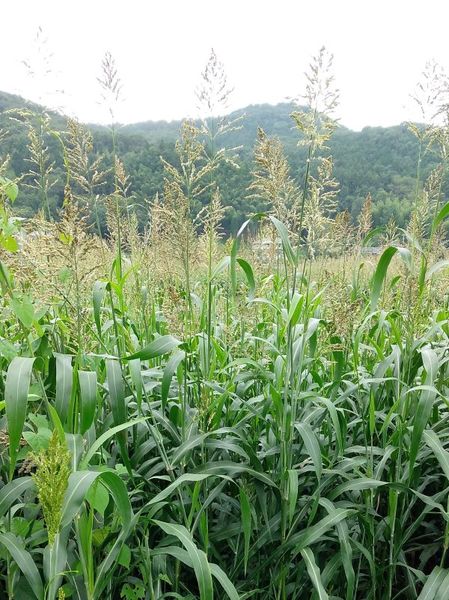
Japanese name: ソルガム Scientific name:Sorghum bicolor
[Overview]
An annual or perennial 3–4 m tall.
There are strains for grain, fodder, sweetener production and other uses.
There are no underground stems.
The culm (stem) is erect, thick and sturdy, and sometimes produces prop roots.
Leaves are simple and alternate, 1 m or more long and up to 10 cm wide, with a thick, distinct midrib.
Many spikelets gather in a panicle-like flower cluster at the tip of the stem.
The spikelets occur in pairs: an awnless, stalked male spikelet and a larger, awned, stalkless bisexual spikelet.
[History]
It was introduced to Japan from China in the Muromachi period and was cultivated as one of the five grains and as a source of sweetener, but today it is grown mainly for fodder.
[Uses]
Besides being used as a grain, it is also a raw material for distilled liquor, syrup, bioethanol and industrial starch.
It is used as fodder and green manure.
It is widely used as a material for brooms.