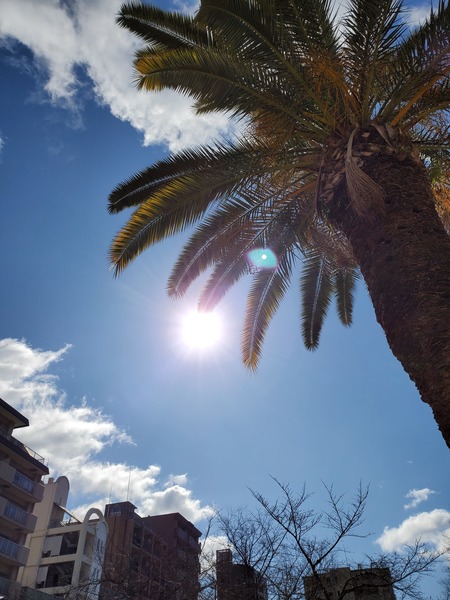
Japanese name: カナリーヤシ Scientific name:Phoenix canariensis
[Overview]
A single-trunked palm growing 10–20 m tall.
The trunk is a thick cylinder up to 1 m across; the bases of fallen petioles remain as diamond-shaped projections, which later drop off and leave a wavy pattern.
The leaves are large pinnate leaves that extend long in an arch, produced densely and in large numbers from the top of the trunk.
The leaves are 4–6 m long, with 80–100 leaflets; the leaflets are lanceolate, 30–45 cm long and stiff, and those at the base are needle-like.
The leaflets are V-shaped in cross section.
The petiole is green and glossy.
It is dioecious, and both male and female inflorescences are spadices emerging from among the leaves.
The flowers are cream to pale yellow, borne singly and spirally on the inflorescence.
The fruit is elliptical, about 2.5 cm long and 1 cm across, ripening yellow to orange; it is not very tasty but is edible.
[Cultivation]
Propagate from seed.
It can overwinter outdoors in regions without frost, and is seen growing in the open west of the Kanto region.
It prefers sunny, well-drained, fertile soil.
It tolerates drought well, and rainfall is sufficient.
From spring to autumn, place slow-release fertilizer on the soil.
Pests and diseases include anthracnose and scale insects.
[Notes]
It is the prefectural tree of Miyazaki.
Most of those grown in Japan are hybrids.