
Plant Encyclopedia

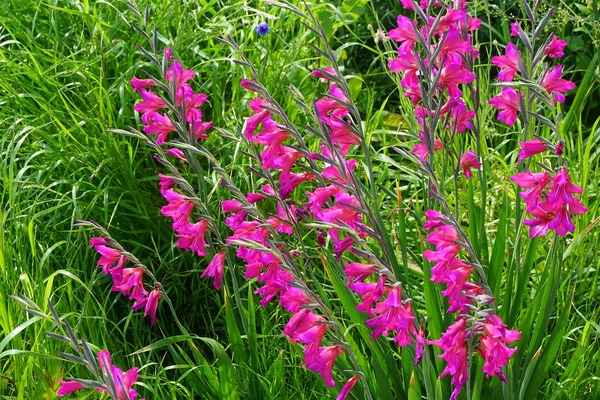
Gladiolus communis subsp. byzantinus (Byzantine gladiolus)
Japanese name: グラジオラス ビザンティヌス
Scientific name: Gladiolus communis subsp. byzantinus
[Overview]
A perennial 60–90 cm tall.
It grows from autumn to spring, and in summer the above-ground parts die back and it goes dormant.
It has an underground corm.
The stem is thin and hard.
The leaves are narrow sword-shaped, about 30 cm long, arranged in a fan of 3–5, and the leaf bases form sheaths that clasp the stem.
A spike-like inflorescence at the stem tip bears about 15 flowers, which open in order from the bottom of the inflorescence.
The flowers are a vivid deep pink tinged with purple, funnel-shaped and about 5 cm in diameter, with a white stripe in the center of each of the 3 lower tepals.
The fruit is a capsule, and the seeds have broad wings.
[Cultivation]
Propagate by dividing the corms.
If the bulbs are planted in early autumn, protect them from frost, for example by moving them into a frame, so that the leaves that emerge are not damaged.
If planted too late, there will be fewer flowers the following spring.
It prefers sunny, well-drained, slightly alkaline soil.
It dislikes acidic soil, so apply magnesian lime when planting.
It dislikes humidity, so during long rainy spells move potted plants to a place out of the rain; for plants in the ground, plant under the eaves or mound up the soil so that rainwater runs off.
Beware of excess moisture when watering; for potted plants, water when the soil surface dries, and for plants in the ground, rainfall is sufficient.
For potted plants, apply slow-release fertilizer in spring before flowering; for plants in the ground it is not particularly necessary.
The stem is thin, so stakes are needed.
Pests and diseases include thrips, aphids and spider mites.
Details
Japanese: グラジオラス ビザンティヌス
Translated from our Japanese encyclopedia. If anything differs, the Japanese page is correct.