
Plant Encyclopedia

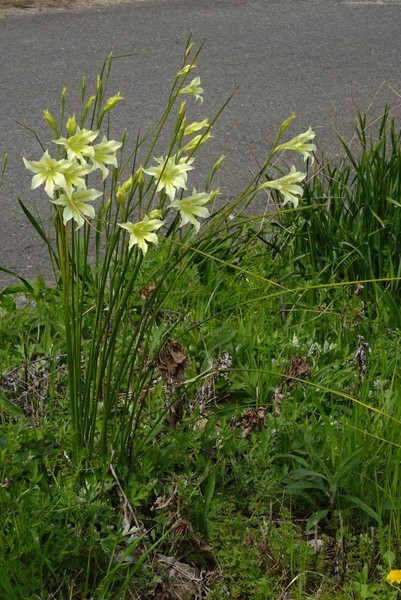
Gladiolus tristis (ever-flowering gladiolus)
Japanese name: グラジオラス トリスティス
Scientific name: Gladiolus tristis
[Overview]
A perennial 50–70 cm tall.
It grows from autumn to spring, and in summer the aboveground part dies back and it becomes dormant.
It has a corm underground.
The stem is thin and hard.
Two to four leaves emerge, cylindrical and twisting spirally toward the tip.
The leaf bases form sheaths that clasp the stem.
A spike-like inflorescence at the stem tip bears several flowers sparsely.
The flowers are tubular, bell-shaped, with 6 petals, and the tepals are pointed at the tip.
The flower color is pale cream or cream with dark green stripes, or with purple to brown brush-like markings.
The flowers have a sweet fragrance, especially strong after evening.
The fruit is a capsule, and the seeds have broad wings.
[Uses]
It is a parent used in breeding spring-flowering gladiolus.
[Cultivation]
Propagate by dividing the bulbs.
When bulbs are planted in early autumn, protect them from frost, for example by moving them into a frame, so that the emerged leaves are not damaged.
If planted too late, the number of flowers the following spring will be reduced.
It prefers sunny, well-drained, slightly alkaline soil.
It dislikes acidic soil, so apply magnesian lime when planting.
It dislikes excessive moisture, so during long rainy spells move potted plants to a place out of the rain, and for plants in the ground, plant them under the eaves or build up a mound so that rainwater drains away.
Be careful not to overwater; for potted plants, water when the soil surface dries.
For plants in the ground, rainfall is sufficient.
For potted plants, apply slow-release fertilizer in spring before flowering.
For plants in the ground, no fertilizer is particularly necessary.
The stem is thin, so a stake is needed.
Pests and diseases include thrips, aphids and spider mites.
Details
Japanese: グラジオラス トリスティス
Translated from our Japanese encyclopedia. If anything differs, the Japanese page is correct.