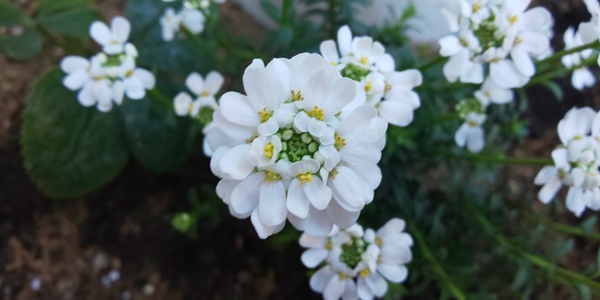
[Overview]
An annual sown in autumn, or an evergreen perennial to subshrub.
Some form dense mounds creeping along the ground, and others reach a height of about 60 cm.
The leaves include basal leaves and stem leaves, both oblanceolate to linear, with entire margins, pinnately lobed, or coarsely toothed.
Racemes or corymbs arise from the leaf axils and bear many flowers.
The inflorescence grows longer as the flowers open.
The flowers are white, pink or reddish purple with 4 petals, and the 2 petals on the outer side of the inflorescence are much enlarged.
Some are fragrant.
The fruit is a silicle.
[Cultivation]
Propagate from seed, by division, or by cuttings of shoots.
It prefers a sunny, airy, well-drained, slightly sandy soil.
It is sensitive to summer humidity and to excess fertilizer.
In spring and autumn, water thoroughly when the soil surface dries; in summer, keep it slightly on the dry side to avoid excess humidity.
In spring and autumn, apply slow-release fertilizer placed on the soil.
Remove spent flowers frequently.
Pests and diseases include aphids and armyworms.
[Notes]
The name Iberis comes from Iberia, an old name for Spain, and was given because many species are distributed in this region.