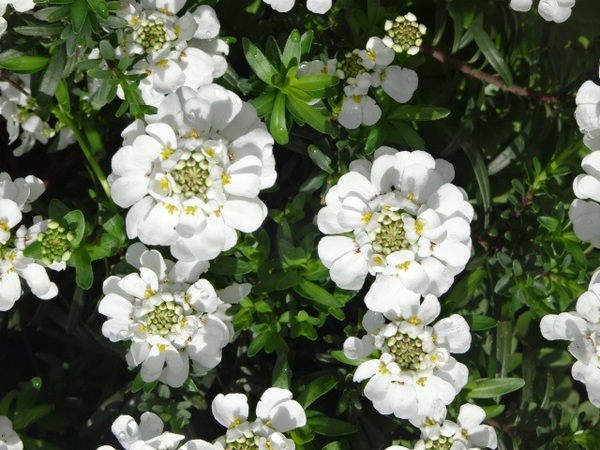
Japanese name: トキワマガリバナ(常盤屈曲花) Scientific name:Iberis sempervirens
[Overview]
An evergreen perennial or subshrub 10–30 cm tall.
The stems branch well and form a dense, bushy clump.
There are basal leaves and stem leaves; the basal leaves are simple, oblanceolate, 1–4 cm long and about 0.5 cm wide, glossy on the upper surface, and entire.
The stem leaves are simple and alternate, and smaller than the basal leaves.
Racemes arise from the leaf axils and bear many flowers.
The inflorescence lengthens as the flowers open.
The flowers are 4-petaled, white or tinged with pink, and the two petals on the outer side of the inflorescence are greatly enlarged.
The fruit is a silicle.
[Cultivation]
Propagate from seed, by division, or by shoot cuttings.
It prefers a sunny, well-ventilated, well-drained, slightly sandy soil.
It is sensitive to summer humidity and excess fertilizer.
In spring and autumn, water thoroughly when the soil surface dries; in summer, keep it somewhat on the dry side to avoid excess moisture.
In spring and autumn, apply slow-release fertilizer placed on the soil.
Remove spent flowers promptly.
Pests include aphids and armyworms.