
Plant Encyclopedia

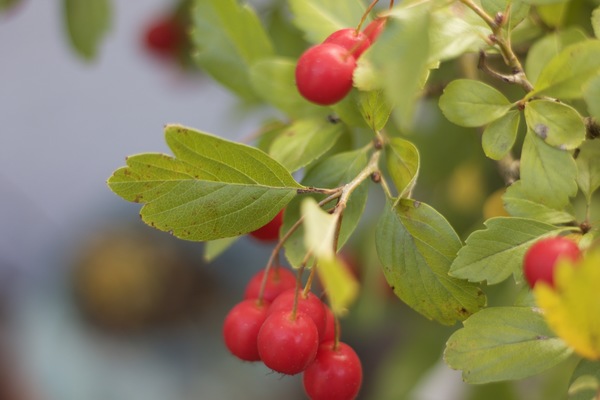
Crataegus cuneata (Chinese hawthorn, "Sanzashi")
Japanese name: サンザシ (山樝子)
Scientific name: Crataegus cuneata
[Overview]
Usually a deciduous shrub 2–3 m tall.
The thorns are about 0.3–0.8 cm long.
Young branches are purplish brown and at first have soft hairs, but later become hairless.
Leaves are simple and alternate, obovate, 2–7 cm long and 1–4.5 cm wide, sometimes with the upper half divided into 3–5 lobes.
The leaf base is wedge-shaped and gradually narrows toward the petiole.
The upper surface of the leaf is glossy, and the underside has soft hairs along the veins.
The leaf margin has irregular double serrations or serrations.
Corymbs at the branch tips bear several white 5-petaled flowers.
The inflorescence, pedicels, calyx tube and calyx have soft hairs.
The flowers are white and 5-petaled, about 1.5 cm across; the petals are nearly round with a slightly clawed base.
There are 20 stamens.
The fruit is spherical, 1–2 cm across, ripening red or yellow, with a slightly depressed tip where the calyx remains.
[History]
Native to China, it arrived in Japan in the middle of the Edo period.
[Uses]
The fruit is edible and is also used medicinally.
[Cultivation]
Propagate from seed, cuttings or grafting.
The rooting rate of cuttings is very low.
Seeds will not germinate once they dry out, so either harvest ripe fruit, wash off the pulp and sow immediately, or bury the seeds in moist vermiculite or similar so they do not dry out and store them in a cool, dark place, then take them out the following spring and wash them well again before sowing.
Keep the soil from drying out until germination.
A sunny, well-drained site that avoids summer dryness and afternoon sun is suitable.
For potted plants, water thoroughly when the soil surface dries; for plants in the ground, rainfall is sufficient unless summer brings a long sunny spell and the soil dries out.
Apply organic fertilizer in winter.
Pests and diseases include powdery mildew, black spot, rust, scale insects, aphids and tteppomushi (longhorn beetle larvae).
Details
Japanese: サンザシ(山樝子)
Translated from our Japanese encyclopedia. If anything differs, the Japanese page is correct.