
Plant Encyclopedia

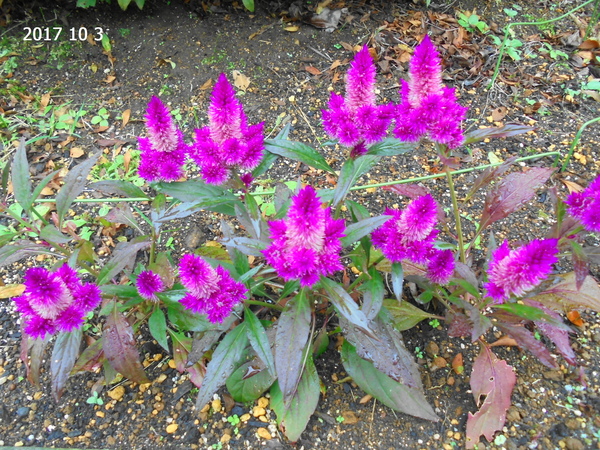
Celosia cristata (Prince of Wales feathers, "Umokeito")
Japanese name: ウモウケイトウ (羽毛鶏頭)
Scientific name: Celosia cristata
[Overview]
An annual.
The stem is erect and thick.
The leaves are alternate and simple, ovate to ovate-lanceolate, 5–20 cm long, with petioles.
Inflorescences are borne in the upper leaf axils and at the stem tips.
The inflorescence is soft and feathery.
Flower colors are abundant, including yellow, orange, red and pink.
[Cultivation]
Propagate from seed.
It has a taproot and dislikes transplanting, so sow directly where it will grow, or if transplanting, take care not to break up the root ball.
The optimal germination temperature is 20 degrees or above, so sow after the temperature has risen sufficiently.
The seeds need darkness to germinate, so cover them with soil and shade them with newspaper or similar until they germinate.
As long as the site is sunny and well drained, it is not very particular about soil.
In fertile soil it produces only leaves, so poorer soil suits it better.
With poor sunlight, the flower color develops poorly.
If it is allowed to dry out in summer its growth declines, so water thoroughly when the soil surface dries.
Fertilizer is not particularly necessary.
Pests and diseases include damping-off, gray mold, aphids, cutworms and spider mites.
Damping-off and gray mold occur more easily when the site is not sunny or well drained.
Also, spider mites appear if dry weather continues.
Because of problems with continuous cropping, it is better to change the planting site every few years.
Details
Japanese: ウモウケイトウ(羽毛鶏頭)、フサゲイトウ(房鶏頭)
Translated from our Japanese encyclopedia. If anything differs, the Japanese page is correct.