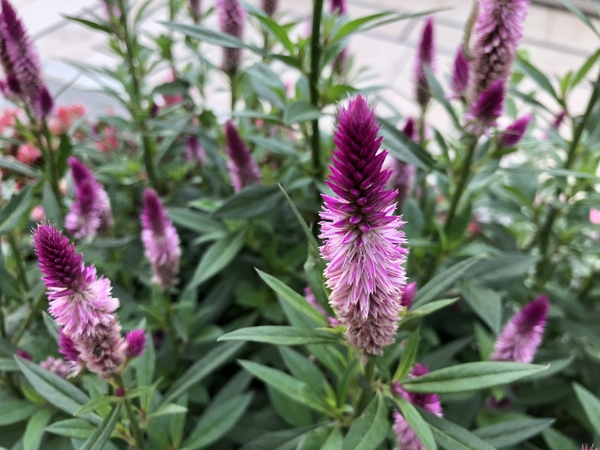
Japanese name: ノゲイトウ(野鶏頭) Scientific name:Celosia argentea
[Overview]
An annual 30–120 cm tall.
The stem is erect and often branched.
The leaves are simple and alternate, ovate to lanceolate, about 5–15 cm long, with entire margins.
There are short petioles.
Inflorescences 2–17 cm long and 1–2 cm in diameter, conical to cylindrical, appear in the upper leaf axils and at the stem tips.
The inflorescences sometimes branch.
The flowers open from the bottom of the inflorescence upward; they are deep pink when they first open, and the parts that have finished flowering turn yellowish white to white.
The fruit is a utricle.
[History]
It came to Japan in the Edo period.
[Uses]
In Africa and Southeast Asia it is used as food and medicine.
[Cultivation]
Propagate from seed.
As long as the site is sunny and well drained, it is not very particular about soil.
For potted plants, water thoroughly when the soil surface dries; for plants in the ground, rainfall is sufficient.
During the growing season, apply slow-release fertilizer placed on the soil.
Pests and diseases include aphids, cutworms and spider mites.