
Plant Encyclopedia

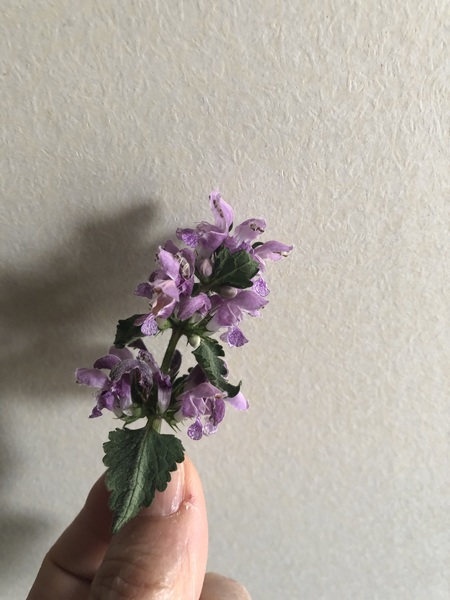
Stachys sieboldii (Chinese artichoke, "Chorogi")
Japanese name: チョロギ (草石蚕)
Scientific name: Stachys sieboldii
[Overview]
A perennial 30–120 cm tall, found in wet places in its native range.
The whole plant is hairy.
Stolons arise from the base of the stem and bear white tubers shaped like spiral shells at their tips.
The stem is square in cross section.
Leaves are simple and opposite, elliptic to ovate, about 3–12 cm long and 1.5–6 cm wide, and toothed.
The leaf surface is wrinkled.
The petiole is 1–3 cm long, and shorter in the upper part of the stem.
A verticillaster 5–15 cm long arises at the top of the stem.
The flowers are purple to pink lipped flowers about 1.3 cm long, with dark spots on the lower lip.
The fruit is a schizocarp.
[History]
It arrived in Japan in the Edo period.
[Uses]
The tubers are eaten, and are also used medicinally under the name sosekisan.
They are often pickled in ume vinegar and colored with red food dye for use in osechi (New Year dishes).
[Cultivation]
Propagation from seed is possible, but it is mainly by tubers.
Plant the tubers immediately after the autumn harvest, or store them in a cool, dark place in moist sand or similar so they do not dry out and plant them the following spring; do not let them go dry until they sprout.
It prefers sun to partial shade and well-drained, moderately moist soil.
Take care not to let it dry out; water thoroughly when the soil surface dries.
It is best fertilized sparingly; if base fertilizer is applied, no further fertilizing is particularly necessary, but for potted plants slow-release chemical fertilizer may be placed on the soil in spring.
If you do not need seed, or want to fatten the tubers, cut off the flower spikes after flowering so the plant does not become exhausted.
Harvest the tubers around October when the leaves begin to wither; quality declines if they dry, so it is best to process or cook them as soon as possible.
There are no particular pests or diseases.
Details
Japanese: チョロギ(草石蚕)
Translated from our Japanese encyclopedia. If anything differs, the Japanese page is correct.