
Plant Encyclopedia

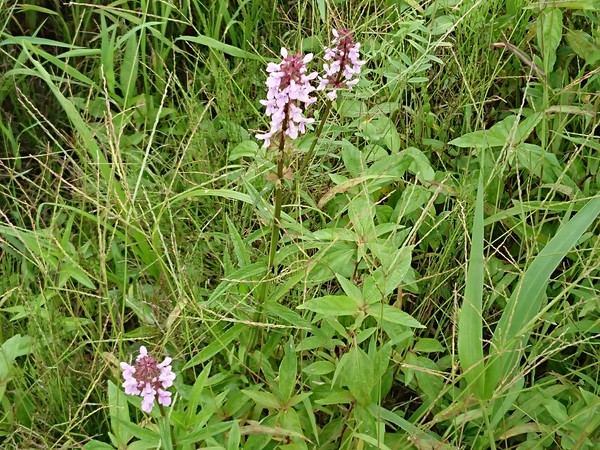
Stachys aspera var. hispidula ("Inugoma")
Japanese name: イヌゴマ (犬胡麻)
Scientific name: Stachys aspera var. hispidula
[Overview]
A perennial 30–70 cm tall, found in wetlands, slightly moist grasslands, and beside irrigation channels.
It has long, creeping white underground stems.
The stem is square in cross section, and the ridges have downward-pointing bristles that make them rough.
Leaves are simple and decussate, lanceolate, about 3–9 cm long and 0.5–2.5 cm wide; the upper surface is wrinkled, and the midrib on the underside has bristles that make it rough.
The leaf margins have low serrations.
The petiole is short.
A whorled cyme appears at the stem tip.
The flowers are pale pink and two-lipped, about 1.5 cm long, with dark spots on the lower lip.
The calyx is divided almost equally into 5 lobes, and the lobe tips are sharply pointed like spines.
The fruit is a schizocarp.
[Cultivation]
Propagate from seed or by division.
It prefers a sunny place.
In the ground, it is best planted at the edge of a pond or beside a channel.
For potted plants, water thoroughly when the soil surface begins to dry, or stand the pot in water or water from the bottom so that it is always kept moist.
If fertilizer is applied at planting, no further fertilizer is particularly needed, but for potted plants liquid fertilizer may be given after flowering, depending on how it is growing.
There are no particular pests or diseases.
[Notes]
The Japanese name comes from the fact that the mericarps resemble sesame but are useless.
The alternative name Chorogi-damashi comes from its resemblance to chorogi.
Details
Translated from our Japanese encyclopedia. If anything differs, the Japanese page is correct.