EVERGREEN

Plant Encyclopedia

Thymus pulegioides

Thymus pulegioides (broad-leaved thyme)

Japanese name: ティムス プレギオイデス
Scientific name: Thymus pulegioides

Thymus pulegioides

[Overview]
An evergreen small shrub 5–25 cm tall, growing on wasteland in its native habitat.
The whole plant is fragrant.
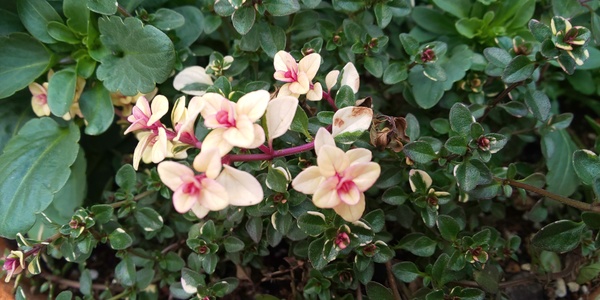
The stems branch well from the base, creep, and spread in a mat.
The stems are tinged with red, square in cross section, and hairy on the ridges.
The leaves are simple and opposite, narrowly ovate, with entire margins.
The flowers are borne in verticillasters at the stem tips; they are two-lipped and pink to magenta.
Four stamens protrude from the corolla.

[Cultivation]
Propagate by cuttings or division.
It prefers sunny, well-drained soil.
It dislikes acidic soil.
It does better on the dry side, so water only after the soil surface has dried completely.
Keep it on the dry side in winter.
For plants in the garden, no watering is needed.
It is weak against heat and humidity, and if the plant becomes stuffy the leaves may die, so cut it back before summer to improve ventilation.
There are no particular pests or diseases.

Details

Names
English: broad-leaved thyme, lemon thyme
Japanese: ティムス プレギオイデス
Life form
Shrub
Evergreen / deciduous
Evergreen
Leaf type
Broadleaf
Habit
Terrestrial
Planting (or sowing) season
March, April, September, October
Flowering season
June, July, August
Distribution or origin
Europe
Growth form
Creeping, Branching
Height
50–250 mm
Leaf shape
Simple leaf (unlobed)
Leaf arrangement
Opposite
Leaf margin
Entire
Inflorescence
Verticillate cyme
Flower color
Purple, Pink
Leaf color
Green
Availability of seeds and plants
Low
Form sold
Seedlings
Propagation
Cuttings, Division
Sun exposure
Full sun
Water needs
Dry, Moderate
Soil needs
Required
Soil acidity
Alkaline, Neutral
Tolerance
Cold tolerance
Suitable uses
Ground cover, Rock garden, Potted plant, Flower bed, Parks and gardens, Slope greening, Wall greening, Rooftop greening, Container, Balcony

Translated from our Japanese encyclopedia. If anything differs, the Japanese page is correct.

Sponsored