
Plant Encyclopedia

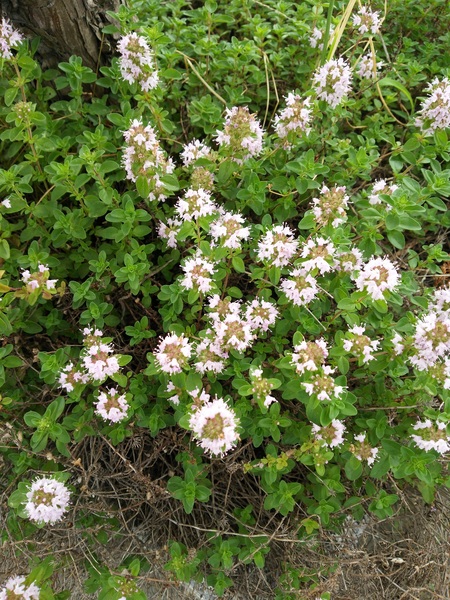
Thymus serpyllum (creeping thyme)
Japanese name: クリーピングタイム
Scientific name: Thymus serpyllum
[Overview]
A small evergreen shrub about 10–15 cm tall.
The whole plant is aromatic.
The stems branch well from the base, creep, and spread in a mat.
Leaves are simple and opposite, elliptic to obovate, 3–8 mm long and 3 mm wide, with entire margins.
The leaves have glandular dots, and the leaf margins bear cilia.
The flowers are borne in whorled clusters at the stem tips; the inflorescence is at first hemispherical but elongates into a cylinder as flowering progresses.
The flowers are two-lipped and pinkish purple, though some are white or pale pink.
Four stamens protrude from the corolla.
[Uses]
It contains essential oil and is used medicinally and in cooking, as well as in potpourri and other items.
[Cultivation]
Propagate from seed, by cuttings, or by division.
It prefers sunny, well-drained, calcareous soil.
It does better on the dry side, so water only after the soil surface has dried completely.
Keep it on the dry side in winter.
Watering is unnecessary for plants in the garden.
It dislikes heat and humidity, and if the plant becomes stuffy the leaves may die, so cut it back by 1/2–1/3 before summer to improve ventilation.
It is very cold-hardy, but the leaves may turn black if exposed to heavy frost.
It needs little fertilizer, and too much weakens the fragrance.
If growing it for harvest, harvest before flowering, because the fragrance weakens once the flowers open.
There are no particular pests or diseases.
Details
Japanese: クリーピングタイム、ヨウシュイブキジャコウソウ(洋種伊吹麝香草)、セルピルムソウ
Translated from our Japanese encyclopedia. If anything differs, the Japanese page is correct.