
Plant Encyclopedia

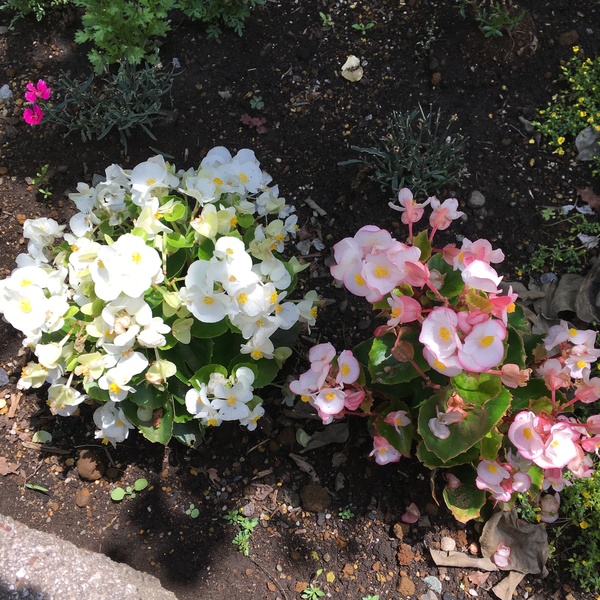
Begonia Semperflorens Cultorum Group
Japanese name: ベゴニア センパフローレンス
Scientific name: Begonia Semperflorens Cultorum Group
[Overview]
A group of horticultural cultivars created by hybridization, said to be based on Begonia cucullata var. hookeri, a variety of Shikizaki-begonia, and related species.
The scientific name Semperflorens-cultorum Group comes from Begonia semperflorens, a synonym of Shikizaki-begonia.
It is divided into three groups: the Semperflorens group, the Gracilis group and the Heterosis group.
It is a succulent perennial, but because it is not cold-hardy it is treated mainly as an annual in horticulture.
The whole plant is hairless and glossy.
The stems are sometimes tinged with red.
The leaves are simple and alternate, ovate to broadly ovate, and asymmetrical.
The leaf margins are irregularly toothed or entire.
There are also bronze-leaved cultivars.
Cymes arise from the leaf axils at the stem tips.
There are male and female flowers; the male flower consists of 2 petal-like sepals and 2 smaller petals, and the female flower consists of 2 petal-like sepals and 3 petals.
[Cultivation]
Propagate by cuttings.
Make cuttings by choosing nodes that have leaf buds.
It prefers soil that is airy and well drained, with moderate water retention.
It prefers a sunny, well-ventilated place; in summer, strong sunlight can cause leaf scorch.
To overwinter it, bring it indoors to a sunny spot before frost falls.
For potted plants, water thoroughly when the soil surface dries in spring and autumn, and keep it somewhat on the dry side in midsummer and winter so that it does not become too wet.
For plants in the ground, rainfall is sufficient.
In spring and autumn, apply slow-release fertilizer once a month, or liquid fertilizer once every 2 weeks.
It weakens in summer heat, so do not fertilize then, and water only enough to keep it from becoming extremely dry.
Pests and diseases include gray mold, powdery mildew and aphids.
Details
Translated from our Japanese encyclopedia. If anything differs, the Japanese page is correct.