
Plant Encyclopedia

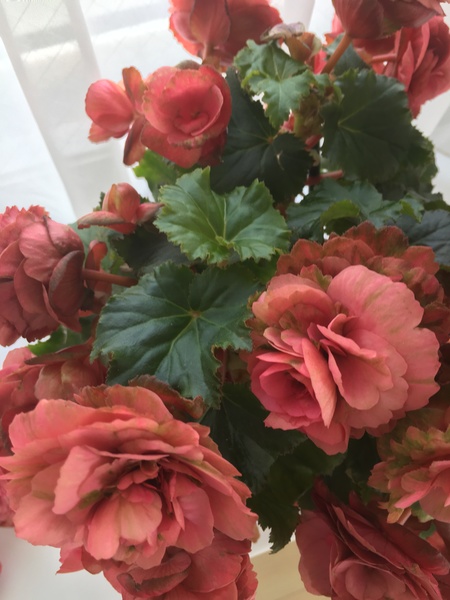
Begonia ×tuberhybrida ("Kyukonbegonia")
Japanese name: キュウコンベゴニア (球根ベゴニア)
Scientific name: Begonia ×tuberhybrida
[Overview]
A group of garden cultivars created by crossbreeding, based on several wild species distributed in the tropical highlands of the Andes.
There are two lines: an upright type (stand type) with thick erect stems, and a trailing type (hanging type) with soft hanging stems; these are further divided into more than 10 groups according to how the flowers bloom and other features.
A succulent perennial.
It has a flat tuber (bulb) underground.
The leaves are simple and alternate, and asymmetrical left to right.
The leaf margins are serrate.
The size, shape and color of the flowers vary.
It is a long-day plant; when day length is 14 hours or more and a suitable temperature is maintained, flower buds form in the leaf axils and flowering continues.
In autumn, as days shorten and temperatures begin to fall, the bulbs begin to swell.
In late autumn the aboveground parts die back, and the plant is dormant in winter.
[History]
There were 7 basic wild species, introduced to Europe in the following years: Begonia boliviensis (1864), B. veitchii (1865), B. cinnabarina (1847), B. clarkei (1867), B. davisii (1876), B. pearcei (1864) and B. rosiflora (1867).
In 1869 the first hybrid cultivar, 'Sendenii', was produced by Veitch in England, and in 1873 several double-flowered cultivars were released.
[Uses]
It is popular in begonia gardens, botanical gardens and the like for its well-formed, showy flowers.
[Cultivation]
Propagate from seed or by stem cuttings.
It cannot be propagated from the bulbs.
The seeds are as small as powder and succulent and easily crushed, so it is difficult for ordinary households.
It prefers airy, well-drained soil with moderate water retention.
Plant the bulbs shallowly, so that the shoots come out of the soil or are only lightly covered.
From autumn to spring, keep it in a sunny place; in summer, strong sunlight causes leaf scorch, so keep it in cool partial shade.
It prefers a well-ventilated place.
The optimum growing temperature is 18–25 °C; it dislikes heat, and growth stops at 30 °C or higher.
It tolerates dryness, and root rot occurs easily when the soil is too wet.
Keep it out of the rain.
In spring and autumn, water thoroughly when the soil surface dries.
At this time, water at the base of the plant, because water on the leaves or flowers can cause disease.
In spring and autumn, apply slow-release fertilizer once a month, or liquid fertilizer once every 2 weeks.
In summer the plant weakens in the heat, so do not fertilize, and water only enough to prevent extreme dryness.
In late autumn, when the aboveground parts begin to die back, keep it on the dry side; when it has died back completely and only the bulb remains, stop watering, or dig up the bulb and store it so that it does not freeze.
After flowering, cut it back to about 1/2 its height, and new branches will grow and flower again.
Support upright cultivars with stakes so that the stems do not break.
Pests and diseases seen include gray mold, powdery mildew, bacterial leaf spot, aphids, spider mites and thrips.
Details
Translated from our Japanese encyclopedia. If anything differs, the Japanese page is correct.