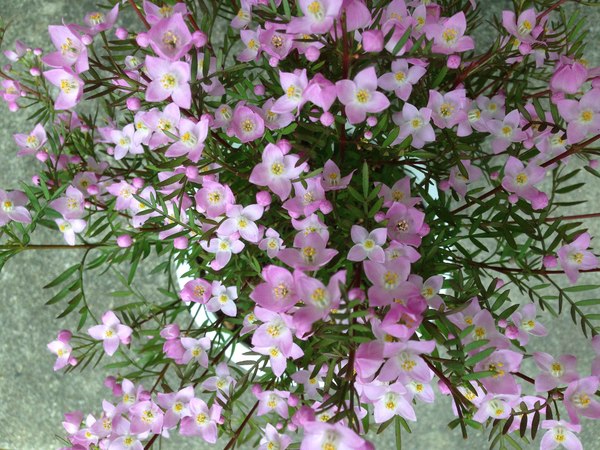
Japanese name: ボロニア ピンナタ Scientific name:Boronia pinnata
[Overview]
An evergreen shrub growing to about 1.5 m tall.
It branches well.
The branches and leaves have a citrus-like fragrance.
The leaves are opposite and odd-pinnately compound, with leaflets 2.5 cm long.
The flowers are borne singly in the leaf axils, about 2 cm across, pink, with four petals opening in a cross shape.
There are 8 stamens, with yellow anthers.
Each flower lasts a long time, and the flowers are numerous.
[Cultivation]
Propagate by cuttings.
It can overwinter outdoors in regions without frost.
It prefers sunny, well-drained acidic soil.
Direct summer sun can scorch the leaves, and dryness can kill the plant, so move potted plants to airy partial shade.
If bringing potted plants indoors in winter, place them where it is sunny and out of the draft of heaters, and mist the leaves from time to time.
Take care that it does not dry out; for potted plants, water thoroughly when the soil surface dries, and for plants in the ground, rainfall is sufficient except in summer.
Apply base fertilizer, and place slow-release chemical fertilizer on the soil during the flowering period.
Spider mites can occur.