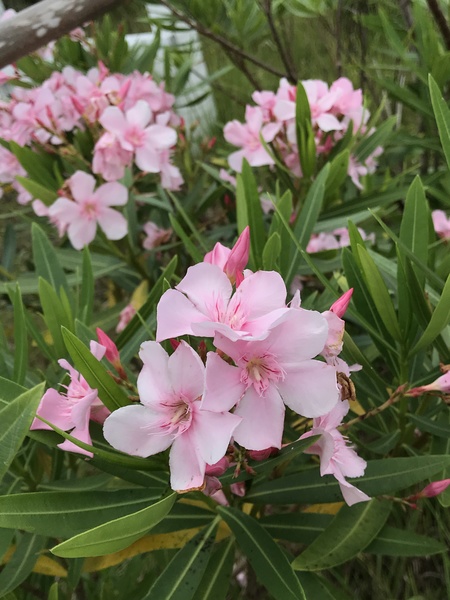
Nerium oleander var. indicum(nerium, "Kyochikuto")
Japanese name: キョウチクトウ(夾竹桃) Scientific name:Nerium oleander var. indicum
[Overview]
An evergreen small tree.
White latex comes out when the stems or leaves are damaged.
The leaves are simple, usually in whorls of 3, oblong, 7–30 cm long and 1.5–2.5 cm wide, hard, thick, and entire.
Cymes emerge at the branch tips.
The flowers are salverform to funnel-shaped, 4–5 cm across, and deeply 5-lobed.
The throat of the corolla has appendages divided threadlike into 4–7 lobes.
The flowers are fragrant, white, pink, red and so on, and come in single and double forms.
The fruit is a follicle, but it forms only rarely.
[History]
It arrived in Japan in the Edo period.
[Uses]
It is well known as a poisonous plant with a cardiotonic action.
[Cultivation]
Propagate by cuttings or layering.
Take cuttings and transplant when temperatures are 25°C or higher.
It prefers sunny, well-drained, moisture-retentive, fertile soil.
For potted plants and plants within one year of being planted in the ground, water thoroughly when the soil surface dries; for plants in the ground that have taken root, rainfall is sufficient.
A small amount of organic fertilizer applied around the plant in winter or early spring is enough.
Pests and diseases include anthracnose and aphids.