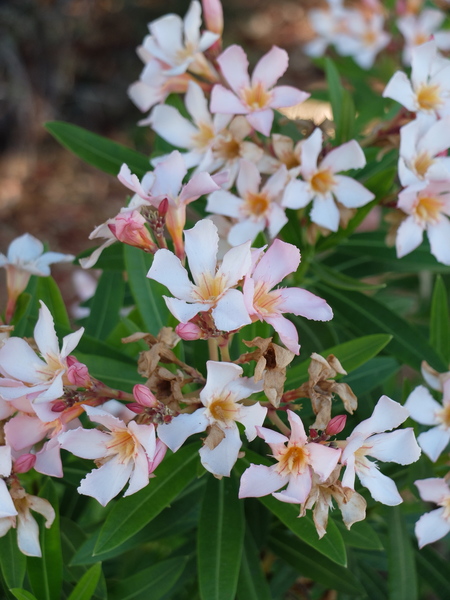
Japanese name: セイヨウキョウチクトウ(西洋夾竹桃) Scientific name:Nerium oleander
[Overview]
An evergreen small tree.
White latex comes out when the stems or leaves are damaged.
The leaves are usually simple and in whorls of 3, oblong, 7–30 cm long and 1.5–2.5 cm wide, hard and thick, with entire margins.
Cymes are borne at the branch tips.
The flowers are salverform to funnel-shaped, 3–4 cm across, and deeply 5-lobed.
The throat of the corolla has appendages that are deeply divided into 3–4 lobes.
The flowers have no fragrance.
Flower colors are white to pink, orange and others.
The fruit is a club-shaped follicle that hangs down and splits open when ripe.
[Uses]
It is well known as a poisonous plant with cardiotonic action.
[Cultivation]
Propagate by cuttings or layering.
Take cuttings and transplant when temperatures are 25°C or higher.
It prefers sunny, fertile soil that is well drained and retains water well.
For potted plants and plants in the ground for less than a year, water thoroughly when the soil surface dries; once established in the ground, rainfall is sufficient.
A small amount of organic fertilizer applied around the plant in winter or early spring is enough.
Pests and diseases include anthracnose and aphids.
[Notes]
Some consider the Islamic oleander (Isuramu-kyochikuto) a separate species.