
Plant Encyclopedia

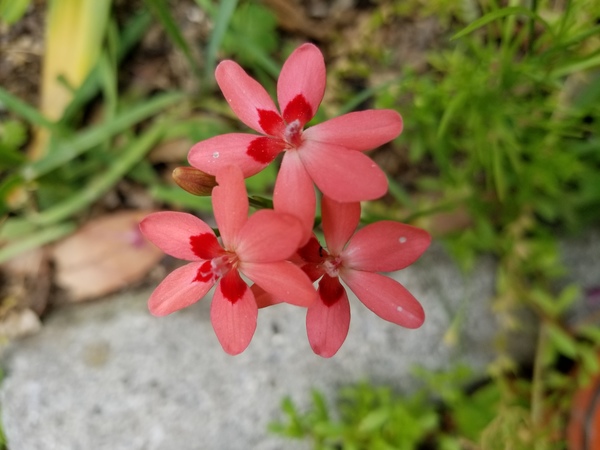
Freesia laxa ("Himehiogi")
Japanese name: ヒメヒオウギ (姫檜扇)
Scientific name: Freesia laxa
[Overview]
A bulbous perennial about 30 cm tall.
Several leaves emerge in a fan shape, linear, about 20 cm long and 1 cm wide.
The upper part of the long, thin flower stalk bends horizontally, and a spike bearing 6–10 upward-facing flowers is produced there.
The flowers are about 2.5 cm across with 6 tepals, bright red, with a dark red blotch at the base of the 3 lower tepals.
The floral tube is about 3 cm long.
There are 3 stamens.
The style of the pistil is slender and branches into 3 at the tip.
There are garden cultivars in various colors.
The fruit is a capsule.
In summer the aboveground part dies back and the plant goes dormant.
[History]
It was introduced to Japan as an ornamental in the Taisho period.
[Cultivation]
Propagate from seed or by bulbs.
The seeds remain viable for as long as 3 years, and in warm regions the plant also multiplies readily by self-sown seed.
It prefers a sunny place that is well drained and retains water well.
Protect it from frost and cold wind.
From leaf emergence until the flowering period, water thoroughly when the soil surface dries, so that it does not become too dry.
After flowering, gradually reduce watering, and do not water during dormancy, although for plants in the ground rainfall is sufficient.
Fertilizer is not particularly necessary, but diluted liquid fertilizer may be given in spring.
Aphids can occur.
[Notes]
The Japanese name comes from its appearance, like a small Hiogi.
Because of its former genus name, it is also sold under the names Rapeirojia or Anomateka.
Details
Translated from our Japanese encyclopedia. If anything differs, the Japanese page is correct.