[Overview]
A bulbous perennial with 11 species known in the wild.
The corm is conical and covered with a fibrous outer coat.
The leaves are arranged in two ranks like a fan.
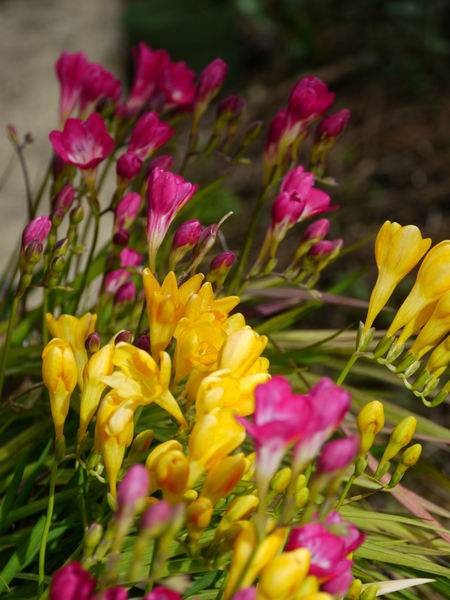
The flowers are funnel-shaped and are arranged facing upward on the part of the upright flower stem whose upper portion bends horizontally.
The flower stem sometimes branches, creeps, or slants.
There are 6 tepals; the 3 inner tepals are larger than the outer ones, and the floral tube swells suddenly partway up.
There are 3 stamens attached to the floral tube, and the style of the pistil is thread-like, with the tip dividing into 3 branches, each of which forks again into two.
The flowers are generally fragrant.
[Uses]
The widely cultivated plants are hybrid cultivars, with a rich variety of flower colors and some double-flowered forms, and they are widely used as potted plants and cut flowers.
[Cultivation]
Propagate by bulbs.
It prefers a sunny place with soil that is well drained and retains moisture.
Protect it from frost and cold wind.