
Plant Encyclopedia

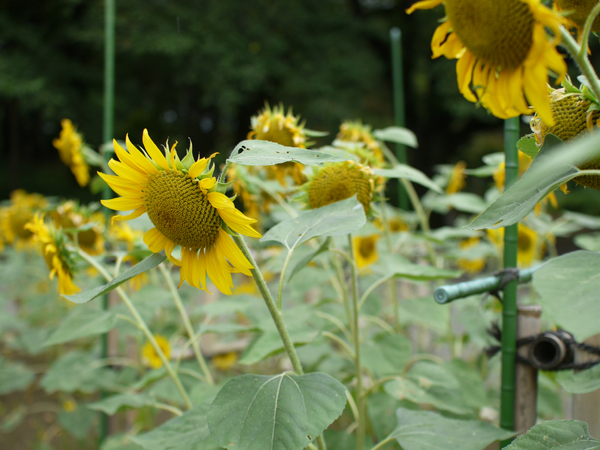
Helianthus annuus (common sunflower, "Himawari")
Japanese name: ヒマワリ (向日葵)
Scientific name: Helianthus annuus
[Overview]
An annual that can reach as much as 3 m in height.
The whole plant is covered with short, stiff hairs and is rough to the touch.
The stem is erect.
The leaves are simple and alternate, oblong and about 20–30 cm long, with toothed margins.
Leaves on the lower part of the stem are sometimes opposite.
They have long leaf stalks.
A large flower head is usually borne singly at the stem tip.
The flower head is 7.5–30 cm across, but large ones reach 40 cm.
The flower head consists of ray flowers and tubular flowers; the ray flowers around the edge are yellow, but depending on the variety they may also be orange, reddish brown, cream or bicolored.
The seeds are long-ovate and slightly flattened; the seed coat is black in oil varieties, while in edible and ornamental varieties it has black and white stripes running lengthwise.
[History]
In the Inca Empire it was regarded as a symbol of the sun god.
It was introduced to Spain by the Spanish in 1510, and in the 17th century.
It arrived in Japan in the Edo period.
[Uses]
It is widely cultivated for ornament, and for its seeds, which are eaten or used as the raw material for sunflower oil.
[Cultivation]
Propagate from seed.
Sow 2–3 seeds directly in each spot, spaced 60 cm apart for large varieties and 15–40 cm apart for others depending on plant height, and when the true leaves begin to emerge, leave the one best-growing plant.
It prefers fertile soil with good sun, drainage, water retention and aeration, but it grows well in most places as long as they are sunny and well drained.
It does not like places that are too dry; especially in the early stage of growth, to prevent it from running short of water, water thoroughly whenever the soil surface dries, both for potted plants and plants in the ground.
Afterward, for plants in the ground, rainfall is sufficient, but tall varieties wilt easily, so water them every day.
Apply organic fertilizer such as compost as base fertilizer, and apply chemical fertilizer twice a month until flowering.
Set up stakes suited to the height to prevent the plants from falling over.
Pests and diseases include downy mildew, aphids and spider mites.
[Notes]
The Japanese name derives from the idea that the flower turns with the movement of the sun, but in fact it does not; in young plants the leaves on the upper part of the stem move so as to face the sunlight, but by the time the flowers bloom growth has stopped, so they do not move.
The flowers often face east if the sunlight is not blocked.
Details
Japanese: ヒマワリ(向日葵)、ヒグルマ(日車)、テンガイバナ(天蓋花)、ニチリンソウ(日輪草)、テンジクアオイ(天竺葵)、ヒュウガアオイ(日向葵)
Translated from our Japanese encyclopedia. If anything differs, the Japanese page is correct.