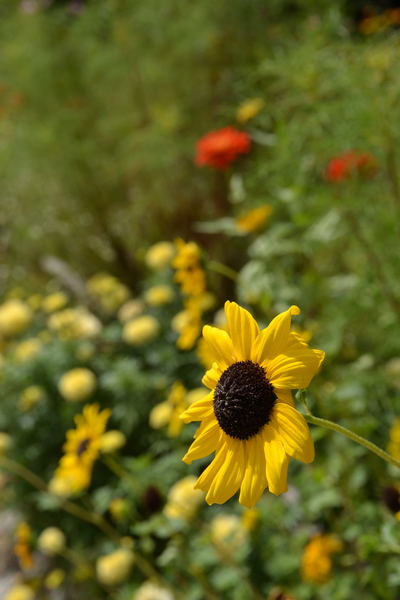
Japanese name: ヒメヒマワリ Scientific name:Helianthus cucumerifolius
[Overview]
A perennial growing to 1.5 m tall, but treated as an annual.
The whole plant is covered with short, stiff hairs and feels rough.
The stems branch freely from the base and are either erect or creeping along the ground.
Leaves are simple and alternate, ovate, 2.5–14 cm long, with a toothed or entire margin.
They have long petioles.
A single flower head 5–7.5 cm across is borne at the stem tip.
The flower head consists of ray florets and tubular florets; the ray florets around the edge are yellow.
The fruit is an achene.
[Cultivation]
Propagate from seed.
It prefers fertile soil that is sunny, well drained and well aerated, but in its native range it grows on sandy or poor soil near the coast, so it grows well in most places as long as they are sunny and well drained.
For potted plants, water thoroughly when the soil surface dries.
For plants in the ground, rainfall is sufficient.
Fertilizing is not particularly necessary if a base fertilizer is applied.
Pests and diseases include aphids and spider mites.