
Plant Encyclopedia

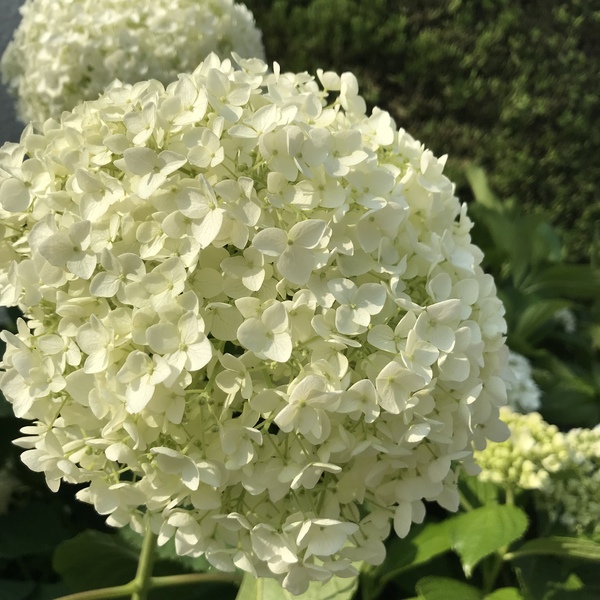
Hydrangea arborescens ‘Annabelle’
Japanese name: アメリカノリノキ‘アナベル’
Scientific name: Hydrangea arborescens ‘Annabelle’
[Overview]
A cultivar of the smooth hydrangea (Amerika-norinoki), native to eastern to southeastern North America.
A deciduous shrub.
The leaves are simple and opposite, ovate to ovate-elliptic, with toothed margins.
The inflorescence is a large ball shape 20–30 cm across with many flowers, consisting only of white, 4-petaled ornamental flowers.
The flowers are green in bud and turn white as they open.
[Cultivation]
Propagate by cuttings.
It prefers moist soil in sun to partial shade that is well drained and retains water well.
Places where the soil becomes extremely dry or that receive strong afternoon sun are unsuitable.
It is easy to grow, vigorous, and flowers well every year.
It absorbs a lot of water, so for potted plants take care not to let them dry out, and water thoroughly when the soil surface dries.
For plants in the ground, watering is not particularly necessary, but during hot periods in summer water in the morning or evening when temperatures are lower.
Apply slow-release chemical fertilizer twice a year, in winter and as thanks fertilizer after flowering.
The flower clusters are large, and when wet with rain the branches may droop because they cannot support the weight, so set up supports or shake off the water.
Unlike other hydrangeas, flower buds form on branches that emerged in spring, so pruning can be done while the plant is leafless.
When the plant has grown large and the branches are crowded, cut it back close to the ground to renew its shape.
There are no particular pests or diseases.
[Notes]
The basic species, Amerika-norinoki, is said to have arrived in Japan in the early Showa period, but it is not widely grown.
Details
Translated from our Japanese encyclopedia. If anything differs, the Japanese page is correct.