
Plant Encyclopedia

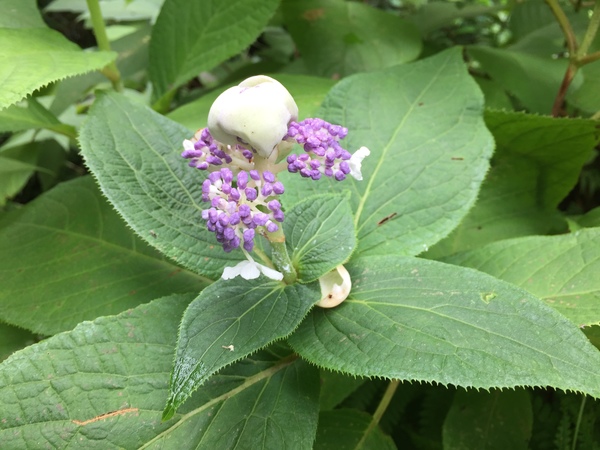
Hydrangea involucrata var. involucrata ("Tamaajisai")
Japanese name: タマアジサイ (球紫陽花)
Scientific name: Hydrangea involucrata var. involucrata
[Overview]
A deciduous shrub about 2 m tall, growing in colonies on fertile ground along mountain streams and on slopes.
It branches freely from the base.
Leaves are simple and opposite, oblong to obovate, 10–25 cm long and 4–12 wide, with many fine, tooth-like serrations on the margins.
Both surfaces of the leaves have stiff hairs and feel rough.
The petiole is 1–9 cm long.
Cyme-like inflorescences are produced at the branch tips; in bud they are spherical and enclosed by several involucres, and the bracts fall off as the inflorescence opens.
The axis of the inflorescence is densely covered with white hairs.
The inflorescence has showy sterile flowers with 3–5 petals, white to purplish white, around the edge, and many pale purple bisexual flowers in the center.
The bisexual flowers are 5-petaled with petals that fall easily, and the 10 stamens are tinged with purple.
The fruit is a spherical capsule about 3 mm across, with the style remaining.
[Cultivation]
Propagate from seed or by cuttings.
It prefers moist soil that is well drained and retains water, in sun to partial shade.
It tolerates shade, but flowers less.
It is unsuitable for places where the soil becomes extremely dry or that receive strong afternoon sun.
It absorbs a lot of water, so to prevent it from drying out, water thoroughly when the soil surface of the pot dries.
Apply slow-release chemical fertilizer twice a year, in winter and as a thank-you fertilizer after flowering.
There are no particular pests or diseases.
[Notes]
The name comes from the fact that, in bud, the inflorescence is enclosed by several involucres and is spherical.
Details
Translated from our Japanese encyclopedia. If anything differs, the Japanese page is correct.