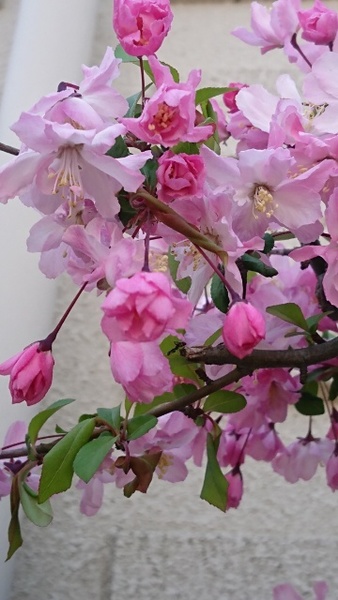
Japanese name: ハナカイドウ(花海棠) Scientific name:Malus halliana
[Overview]
A deciduous shrub growing to about 5 m tall.
Young branches are at first slightly hairy.
The leaves are simple and alternate, elliptic, 3.5–8 cm long and 2.5–4.5 cm wide, with a glossy upper surface and fine serrations along the margin.
The leaf stalk is 0.5–2.5 cm.
The flowers are pale pink with 5 petals and open halfway; because of their long flower stalks of 4–6 cm, they hang down as they bloom.
There are also double-flowered cultivars.
The fruit is a spherical pome about 0.6–0.8 cm in diameter, with the calyx persisting at the apex.
[History]
The place of origin is unknown (central-western China?), but in China it has long been cultivated as an ornamental.
It was introduced to Japan during the Shotoku era (1711–1716) of the Edo period.
[Cultivation]
Propagate from seed, cuttings, or grafting.
It prefers a sunny, well-drained, well-ventilated, moderately moist and fertile site.
Avoid dry places and places exposed to strong afternoon sun.
For potted plants, water thoroughly when the soil surface dries.
For plants in the ground, rainfall is sufficient.
Apply organic fertilizer in winter, and give fertilizer after flowering as well.
Pests and diseases include cedar-apple rust, powdery mildew, leaf rollers and aphids.