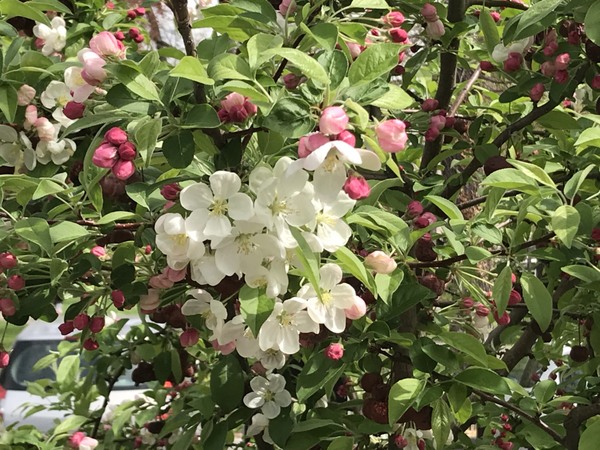
Japanese name: リンゴ(林檎) Scientific name:Malus pumila
[Overview]
A deciduous tree that reaches several meters in height if left alone.
It is a cultivated-origin species said to have originated in the Caucasus and Asia Minor, and is one of the oldest fruit trees.
The branches tend to be upright in young trees, but become somewhat drooping once the tree matures and bears many fruits.
The leaves are alternate, elliptic to ovate, with the tip drawn out into an awn-like point and toothed margins.
Short hairs grow densely on the underside of the leaves.
The flowers are borne 5–7 in cymes.
They are 5-petaled flowers that are reddish in bud and turn white when open.
The fruit is a pome, and the flesh is a developed part of the receptacle.
It is a close relative of Nashi, but Ringo differs in that the flowers are borne in cymes (in Nashi, corymbs), the anthers of the stamens are yellow (in Nashi, purple), the bases of the styles of the pistil are fused (in Nashi, separate), and the flesh contains almost no stone cells (in Nashi, it does).
There are many cultivars, but the one widely grown is a group called the Delicious group.
[Cultivation]
Propagate by grafting.
It prefers a sunny, well-drained site.
Pests and diseases are numerous, so caution is needed.