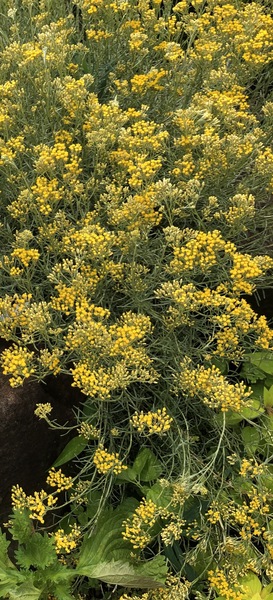
Japanese name: カレープラント Scientific name:Helichrysum italicum subsp. serotinum
[Overview]
An evergreen shrub 40–60 cm tall.
The stems are covered with silvery gray down, and are woody and sturdy.
The leaves are simple, alternate and linear, covered with silvery gray down.
Small yellow flower heads are borne in clusters at the stem tips.
The flower heads consist only of tubular flowers.
The fruit is an achene.
[Uses]
The stems and leaves smell of curry and can be dried and used to flavor dishes, but because they are bitter, they are mostly used as dried flowers and potpourri.
[Cultivation]
Propagate by cuttings.
It prefers a sunny, well-drained place.
In poor sun, the leaves drop and flowers form less easily.
Avoid direct sunlight in summer and frost in winter.
It can overwinter down to about -5°C as long as it is not exposed to frost.
It prefers slightly dry soil, so water when the soil surface dries.
It is better to keep fertilizer light.
Because the branches and leaves grow densely, the plant may rot or contract root rot if it becomes stuffy in summer.
Before the rainy season, thin out crowded branches or cut the plant back hard.
Root rot can occur.