
Plant Encyclopedia

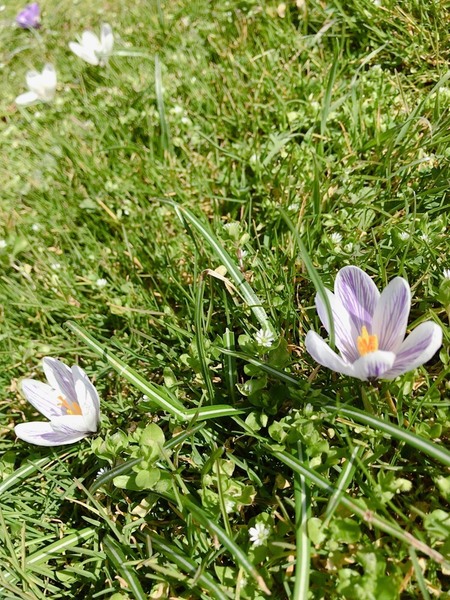
Crocus (genus, crocus, "Kurokkasu")
Japanese name: クロッカス
Scientific name: Crocus
[Overview]
A bulbous plant about 10 cm tall.
Most bloom in early spring, but there is also an autumn-flowering group.
Underground, the stem is shortened and swollen into a corm, which is what is called the crocus bulb.
The outer coat of the corm is fibrous, membranous or leathery depending on the species, and serves as a guide to distinguishing species.
The leaves are basal and linear, with a bluish white to silvery groove running down the center of the upper side and usually two grooves on the underside.
The base of the leaves is enclosed in a thin membranous sheath.
At flowering time the leaves are shorter than the flowers; they lengthen after the flowers finish, and spring-flowering types die back and go dormant around June.
One to several flowers emerge from the center of the leaves.
The flowers are tubular with a narrow base and have 6 petals, in a wide range of colors including white, yellow, purple, wisteria, bluish purple and reddish purple.
The flower tube is long and the ovary is underground, but the fruit ripens above ground.
[Cultivation]
Propagate by bulbs.
It prefers sunny, well-drained sandy soil rich in organic matter.
At least while the leaves are out, place it where it gets sun for half a day or more. If sunlight is poor, the bulbs do not grow large, and flowering will be poor from the next year on.
Overwatering rots the bulbs, so water only when the soil has dried.
Apply base fertilizer at planting and top-dress with a potassium-rich fertilizer after flowering, but take care because too much will rot the bulbs.
Once the leaves have died back, dig up the bulbs and store them, or leave them planted if the site is well drained.
Spring-flowering types will not bloom unless they are exposed to winter cold for a certain period.
Diseases and pests include dry rot, soft rot and mosaic disease.
Details
Japanese: クロッカス
Translated from our Japanese encyclopedia. If anything differs, the Japanese page is correct.