
Plant Encyclopedia

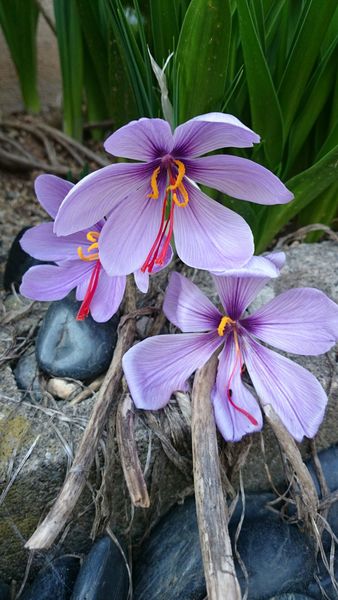
Crocus sativus (saffron, "Safuran")
Japanese name: サフラン
Scientific name: Crocus sativus
[Overview]
A bulbous plant of cultivated origin, about 10–15 cm tall.
The stem is shortened and swollen underground to form a corm (bulb).
The corm is wrapped in a fibrous outer coat.
Ten or more leaves grow from the base, linear and 1–3 mm wide, with a bluish-white groove running down the center of the upper surface.
The leaf bases are wrapped in a thin membrane like a sheath.
The leaves already stand taller than the flowers before flowering, but grow longer after the flowers have finished.
One to four flowers emerge from the center of the leaves.
The flowers are tubular, narrowing at the base, fragrant, with 6 pale purple petals.
The style is red, divided into three, and hangs down long.
Because it is triploid, it does not produce seed.
[Uses]
The styles are used to color and flavor food, in paella, bouillabaisse, saffron rice and other dishes.
It is also used as a dye, as medicine, as a fragrance, and as tea.
As a crude drug it is called bankoka.
The styles are harvested by hand, and about 160 flowers are needed to obtain 1 g of saffron, so it is expensive.
[History]
It is thought to have originated on Crete in ancient Greece, and has been used since that time.
It came to Japan at the end of the Edo period as a crude drug.
Today, production areas in Japan include Taketa in Oita and Shiogama in Miyagi.
[Cultivation]
Propagate by bulbs.
It prefers a cool environment with sunny, humus-rich, well-drained sandy soil.
Place it where it receives at least half a day of sun, at least while the leaves are out.
If it is too shady, the bulbs do not grow large, and flowering will be poor from the following year on.
Overwatering makes the bulbs rot, so water only when the soil has dried.
Apply base fertilizer at planting, and top-dress with a fertilizer high in phosphorus after flowering and in early spring; take care, because too much fertilizer makes the bulbs rot.
When the leaves die back in spring, either dig up the bulbs and store them, or leave them planted where drainage is good.
Diseases and pests include dry rot, soft rot and mosaic disease.
Details
Japanese: サフラン
Translated from our Japanese encyclopedia. If anything differs, the Japanese page is correct.