EVERGREEN

Plant Encyclopedia

Althaea officinalis

Althaea officinalis

Japanese name: マーシュマロウ
Scientific name: Althaea officinalis

Althaea officinalis

[Overview]
A perennial growing to about 1 m tall.
The stems and leaves have soft hairs and feel velvety.
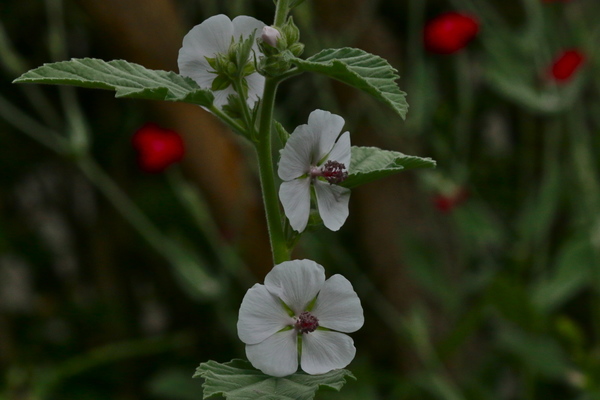
Leaves are simple and alternate, ovate to heart-shaped, shallowly palmately lobed, with long leaf stalks.
The flowers are borne singly in the leaf axils; they have 5 petals, are 2–3 cm across, and are pale pink to red.
The fruit is a ring of mericarps that do not split open even when ripe.

[Uses]
The root is called Altea root (arutea-kon) and is used as a stomach medicine and an excipient; it is also said to have been the prototype of the confection marshmallow.
The young leaves and flowers are used as herbal tea.

[Cultivation]
In horticulture it is often treated as an annual or biennial.
It prefers fertile soil that is well drained and sunny.
Propagate from seed.
Leafrollers can occur.

Details

Names
Japanese: マーシュマロウ、ウスベニタチアオイ(薄紅立葵)、ビロードアオイ、マシュマロウ
Life form
Perennial
Evergreen / deciduous
Deciduous
Habit
Terrestrial
Planting (or sowing) season
April, May, September, October
Flowering season
July, August
Distribution or origin
Eastern Europe
Growth form
Upright
Height
1000 mm
Leaf shape
Lobed leaf
Leaf arrangement
Alternate
Leaf margin
Serrate
Inflorescence
Solitary
Number of petals
5
Flower color
Pink, Red
Flower diameter
20–30
Leaf color
Green
Availability of seeds and plants
Low
Form sold
Seedlings
Propagation
Seed
Sun exposure
Full sun
Water needs
Moderate
Soil needs
Required
Suitable uses
Flower bed, Parks and gardens
Pests
Leafrollers
Edible parts
Leaves, Flowers
Uses
Beverage, Medicinal
Japan Flower Trade Code
64090

Translated from our Japanese encyclopedia. If anything differs, the Japanese page is correct.

Sponsored