
Plant Encyclopedia

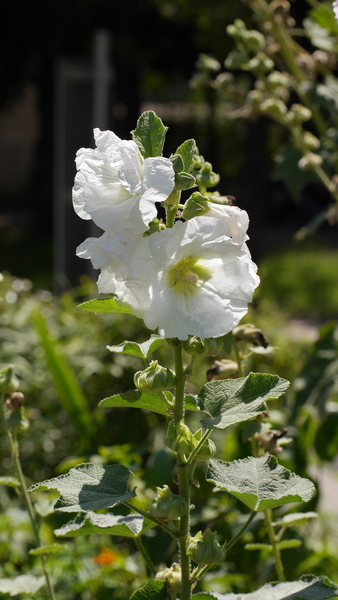
Althaea rosea (hollyhock, "Tachiaoi")
Japanese name: タチアオイ
Scientific name: Althaea rosea
[Overview]
A biennial about 3 m tall.
The whole plant is hairy.
The leaves are simple and alternate, heart-shaped, and shallowly palmately divided into 5–7 lobes.
The leaf margin has teeth.
The petioles are long.
The flowers, 1–2 in the leaf axils in the upper part of the stem, have 5 petals and come in a wide variety of colors.
The flowers bloom in order from the bottom of the stem upward.
The fruit is a ring of mericarps that do not split open even when ripe.
[History]
It came to Japan from China long ago for medicinal and ornamental use.
It has long been regarded as native to China, but its place of origin is unknown, and it is now thought to be of hybrid origin.
[Uses]
The root is used medicinally as a substitute for marshmallow root (althaea root), and the flowers are also used medicinally.
[Cultivation]
Propagate by division and from seed.
It prefers fertile soil with good sun, drainage and air circulation.
When planted in the garden, it needs almost no watering.
For potted plants, water thoroughly when the soil dries.
Care is needed, as high humidity can cause root rot.
Apply slow-release fertilizer as a base fertilizer at planting; if not repotting, place slow-release fertilizer on the soil in spring.
Pests and diseases include leaf spot, anthracnose, viral disease, leafrollers and aphids.
Details
Japanese: タチアオイ、ホリホック
Translated from our Japanese encyclopedia. If anything differs, the Japanese page is correct.