
Plant Encyclopedia

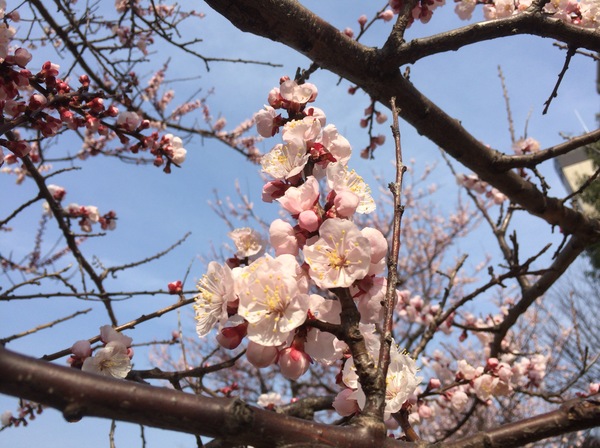
Armeniaca vulgaris (apricot, "Anzu")
Japanese name: アンズ (杏)
Scientific name: Armeniaca vulgaris
[Overview]
A small deciduous tree 5–10 m tall, introduced long ago as a medicinal plant.
The bark is reddish, and the young branches are purplish brown and hairless.
Leaves are simple and alternate, broadly ovate to ovate-round, with fine serrations on the margin. The leaf base is rounded and has glandular dots, and the leaf is hairless except for hairs at the base of the veins.
The petiole is longer than that of Ume and sometimes has glandular dots.
Flowers are borne 1–2 on the previous year's branches; they are pale pink and 5-petaled, and open before the leaves emerge.
There is no flower stalk.
The fruit ripens to pale greenish yellow to yellowish orange.
[Uses]
The fruit is processed into dried fruit, jam and so on.
The kernel, which is the seed, is used as a crude drug and as food.
[History]
There is a European group of cultivars, which passed through Persia to Greece during the Former Han period and was improved there, and an East Asian group.
Today, improvement as a fruit tree has advanced and it is cultivated in many regions.
It was introduced to Japan as a medicinal plant, and its name already appears in the Man'yoshu.
[Cultivation]
In Japan it is suited to cultivation in cool regions, and it prefers a sunny, well-drained site.
It grows well in fertile soil, but it is also quite drought tolerant.
Propagate mainly by grafting.
Pests and diseases include black spot, branch blight, aphids and the peachtree borer.
Details
Japanese: アンズ(杏)、カラモモ(唐桃)
Translated from our Japanese encyclopedia. If anything differs, the Japanese page is correct.