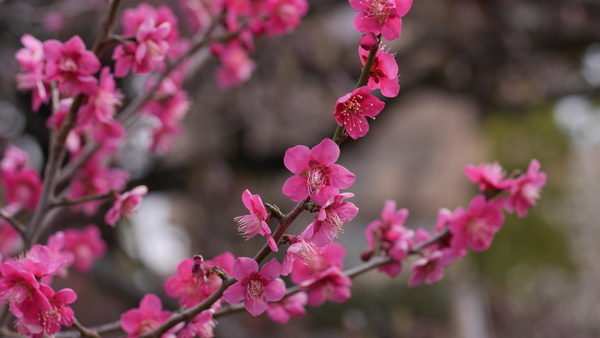
Japanese name: ウメ(梅) Scientific name:Armeniaca mume
[Overview]
A deciduous tree introduced long ago as a medicinal plant.
The branches grow well, ascending obliquely or straight up, and young branches are green.
Leaves are alternate, ovate, 5–8 cm long, with doubly serrate margins.
There are glandular spots at the base of the leaf or at the top of the petiole.
The stipules are lanceolate.
The flowers open around February–March, before the leaves.
They have almost no stalk and are about 2.5 cm across, usually with 5 petals and a brownish purple calyx.
The flowers have an elegant fragrance.
The fruit ripens yellow in June and is often tinged with red.
[Overview]
The fruit is used for umeshu (plum liqueur) and umeboshi (pickled plums), and is also medicinal.
Not only the flowers but also the branching and the shape of the tree are appreciated.
Because of the popularity of plum-blossom viewing and the spread of umeboshi, many cultivars have been created or imported.
[Cultivation]
It prefers a sunny, well-drained site.
It grows well in fertile soil, but it is also fairly drought tolerant.
It is sensitive to air pollution.
Transplanting is easy, and even old trees can be replanted.
It sprouts vigorously, so it is easy to prune into shape.
Propagation is mainly by grafting.
Pests include aphids and tent caterpillars.