EVERGREEN

Plant Encyclopedia

Phyla canescens

Phyla canescens (carpet weed, "Himeiwadareso")

Japanese name: ヒメイワダレソウ (姫岩垂草)
Scientific name: Phyla canescens

Phyla canescens

[Overview]
A perennial.
The stems creep along the ground, rooting at the nodes, and spread in a mat.
The leaves are simple and opposite, spatulate-ovate to lanceolate, about 1–2.5 cm long, somewhat fleshy, with blunt teeth along the margins.
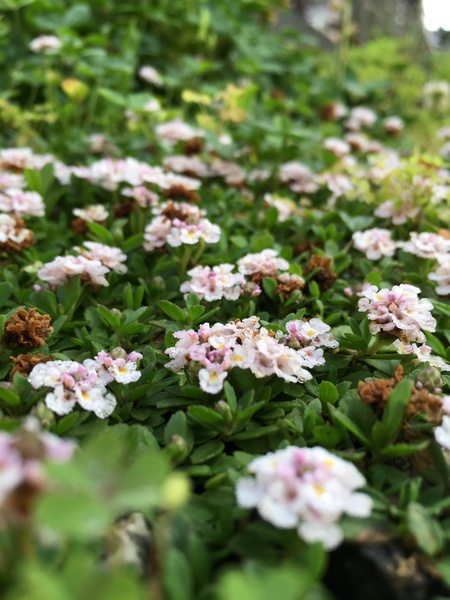
The flowers are densely borne in spikes arising from the leaf axils.
It resembles Iwadare-so, but can be distinguished by its inflorescence, which is a short cylinder or head.
The inflorescence is about 1 cm in diameter.
The corolla is tubular, with the tip divided into 5 somewhat lip-shaped lobes, and is usually pale pink with a yellow throat.

[Uses]
Besides horticultural use, it is also used for greening slopes and similar purposes.

[Cultivation]
Propagate by division or stem cuttings.
It prefers a sunny place and is easy to grow.

Details

Names
English: carpet weed, hairy fogfruit, mat grass, Condamine couch, Condamine curse, fog fruit, lippia, no-mow grass
Japanese: ヒメイワダレソウ(姫岩垂草)
Life form
Perennial
Habit
Terrestrial
Similar plants
Planting (or sowing) season
April, May, June, July
Flowering season
May, June, July, August, September
Distribution or origin
South America
Growth form
Creeping
Leaf shape
Simple leaf (unlobed)
Leaf arrangement
Opposite
Leaf margin
Serrate
Inflorescence
Spike
Flower color
Pink
Flower diameter
10
Leaf color
Green
Availability of seeds and plants
Low
Form sold
Seedlings
Propagation
Division, Bud cuttings
Sun exposure
Full sun
Water needs
Moderate
Soil needs
Required
Tolerance
Drought tolerance
Suitable uses
Ground cover, Flower bed, Parks and gardens, Slope greening, Rooftop greening, Paddy field greening
Japan Flower Trade Code
52900

Translated from our Japanese encyclopedia. If anything differs, the Japanese page is correct.

Sponsored