EVERGREEN

Plant Encyclopedia

Phyla nodiflora

Phyla nodiflora (frog fruit, "Iwadareso")

Japanese name: イワダレソウ (岩垂草)
Scientific name: Phyla nodiflora

Phyla nodiflora

[Overview]
A perennial found on sunny seashores.
The stems creep along the ground, rooting at the nodes, and spread to form a mat.
The stems have ridges.
The leaves are simple and opposite, obovate-elliptic, 1–4 cm long and 0.5–1.8 cm wide, somewhat fleshy, with coarse teeth along the margin of the upper half.
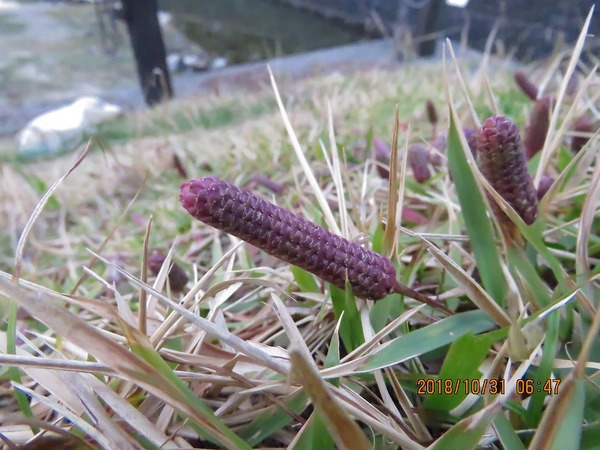
The flowers are borne densely on cylindrical spike-like inflorescences arising from the leaf axils.
The inflorescence stalk is longer than the leaves.
The corolla is pale reddish purple to white, 0.2 cm across, with the tip divided into 5 somewhat lip-shaped lobes.
The bracts are fan-shaped and deep purple.
The inflorescence elongates as flowering progresses.
The fruit is a schizocarp.

[Cultivation]
Propagate by division or by stem-tip cuttings.
It prefers a sunny location and is easy to grow.

Details

Names
English: frog fruit, sawtooth fogfruit, turkey tangle
Japanese: イワダレソウ(岩垂草)
Life form
Perennial
Habit
Terrestrial
Similar plants
Planting (or sowing) season
April, May, June, July
Flowering season
July, August, September, October
Distribution or origin
Japan (Honshu: southern Kanto to Ryukyu), tropical to subtropical regions worldwide
Growth form
Creeping
Leaf shape
Simple leaf (unlobed)
Leaf arrangement
Opposite
Leaf margin
Serrate
Inflorescence
Spike
Flower color
Pink, White
Flower diameter
2
Leaf color
Green
Availability of seeds and plants
Low
Form sold
Seedlings
Propagation
Division, Bud cuttings
Sun exposure
Full sun
Water needs
Moderate
Soil needs
Required
Tolerance
Drought tolerance
Suitable uses
Ground cover, Rock garden, Parks and gardens, Rooftop greening
Japan Flower Trade Code
42866

Translated from our Japanese encyclopedia. If anything differs, the Japanese page is correct.

Sponsored