EVERGREEN

Plant Encyclopedia

Solanum melongena

Solanum melongena (eggplant, "Nasu")

Japanese name: ナス (茄子、茄)
Scientific name: Solanum melongena

Solanum melongena

[Overview]
A perennial cultivated as an annual crop.
The stems branch well and become small shrub-like.
The color of the stems and leaf stalks is, in most of those cultivated in Japan, a glossy blackish purple.
Some have leaves tinged with purple.
The flowers are borne in the leaf axils, white to pale purple, and the petals are 5–8-lobed.
There are many cultivars.
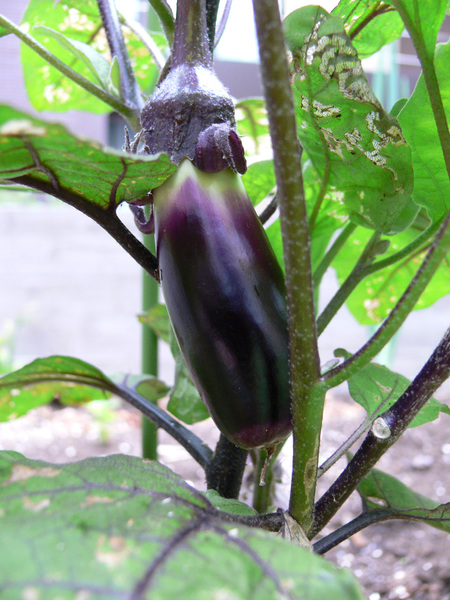
The fruit varies with the cultivar, being spherical, ovate, long-ovate and so on; the skin is usually blackish purple, but white or green ones also exist, and they turn yellow when ripe.

[History]
It has been seen in China since around the 5th century BC, and was first recorded in Japan in 750.

[Cultivation]
Care is needed because it is prone to problems from continuous cropping and to soil-borne diseases.

Details

Names
English: eggplant, aubergine, brinjal, Jew's apple, mad apple, melongene
Japanese: ナス(茄子、茄)、ナスビ
Life form
Annual, Perennial
Habit
Terrestrial
Planting (or sowing) season
April, May
Flowering season
June, July, August, September, October
Fruiting season
June, July, August, September, October
Distribution or origin
Presumed to be India
Leaf shape
Simple leaf, Lobed leaf
Leaf arrangement
Alternate
Leaf margin
Entire, Incised
Inflorescence
Cyme
Flower color
White, Purple
Fruit color
Purple, White, Green
Leaf color
Green
Availability of seeds and plants
Low
Form sold
Seedlings
Sun exposure
Full sun
Soil needs
Required
Suitable uses
Potted plant, Flower bed, Container, Balcony
Diseases
Powdery mildew
Pests
Aphids, Twenty-eight-spotted ladybirds, Whiteflies, Spider mites, Tobacco cutworms, Cutworms
Edible parts
Fruit
Uses
Edible
Special days
Obon, Sankunichi
Japanese culture
First Fuji, second hawk, third eggplant
Japan Flower Trade Code
48448

Translated from our Japanese encyclopedia. If anything differs, the Japanese page is correct.

Sponsored