EVERGREEN

Plant Encyclopedia

Pyrus pyrifolia var. culta

Pyrus pyrifolia var. culta (nashi pear)

Japanese name: ナシ (梨)
Scientific name: Pyrus pyrifolia var. culta

Pyrus pyrifolia var. culta

[Overview]
A deciduous tree 15 m tall.
A group of cultivars derived from the yamanashi (wild pear), which is native to China and also grows in Japan.
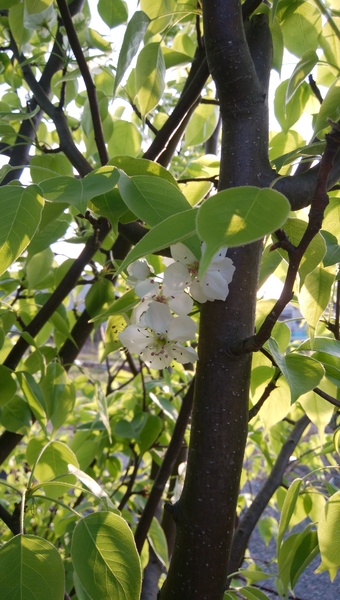
Leaves are simple and alternate, ovate to oblong-ovate, about 12 cm long, glossy, with fine serrations.
The flowers are white, five-petaled, and bloom in April.
The fruit is nearly spherical, and there are two lines: the red pears (aka-nashi) with brown skin and the green pears (ao-nashi) with yellowish-green skin.
The flesh is white, sweet and juicy, and because it contains many stone cells it has a crisp, gritty texture.
There are many cultivars.

[History]
There are records of cultivation from the Nara period.

[Cultivation]
Propagate by cuttings.
It prefers well-drained soil.
Do not plant Ibuki plants, the intermediate host of pear rust, nearby.

Details

Names
English: nashi pear, Chinese pear, Japanese pear
Japanese: ナシ(梨)、ニホンナシ(日本梨)、ワナシ(和梨)
Life form
Tree
Evergreen / deciduous
Deciduous
Leaf type
Broadleaf
Habit
Terrestrial
Planting (or sowing) season
February, March, November, December
Flowering season
April
Fruiting season
July, August, September, October
Growth form
Upright
Height
15000 mm
Leaf shape
Simple leaf
Leaf arrangement
Alternate
Leaf margin
Serrate
Inflorescence
Corymb
Number of petals
5
Flower color
White
Fruit color
Green, Brown
Leaf color
Green
Availability of seeds and plants
Low
Form sold
Seedlings
Propagation
Cuttings
Sun exposure
Full sun
Soil needs
Required
Suitable uses
Parks and gardens
Diseases
Akaboshi disease, Black spot, Scab
Pests
Aphids, Scale insects, Borers, Longhorn beetles
Edible parts
Fruit
Uses
Edible
Japan Flower Trade Code
19461

Translated from our Japanese encyclopedia. If anything differs, the Japanese page is correct.

Sponsored