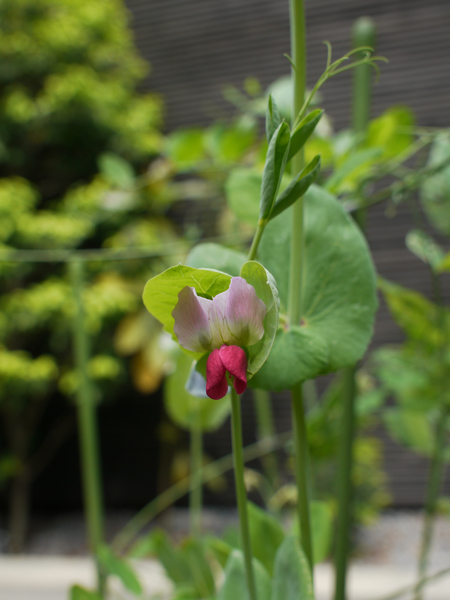
Japanese name: エンドウ(豌豆) Scientific name:Pisum sativum
[Overview]
A cold-hardy climbing annual.
Green peas are included in this species.
The stems and leaves are covered with a waxy coating and look whitish.
The stem is hollow.
The leaves are alternate and pinnately compound, with the terminal leaflets changed into tendrils.
There are two well-developed stipules at the base of each leaf.
From the upper leaf axils, forked flower stalks 2–5 cm long emerge, often bearing two flowers.
The flowers are butterfly-shaped (papilionaceous) and reddish purple or white.
The fruit is a flat legume.
[History]
Globally it has been cultivated for about as long as wheat, but it was not introduced to Japan in earnest until the Meiji era.
[Cultivation]
It prefers neutral soil that is sunny, moisture-retentive and well drained.
It does not tolerate continuous cropping, and growth is poor in acidic soil.
[Notes]
It is the plant with which Mendel carried out his research on heredity and discovered Mendel's laws.