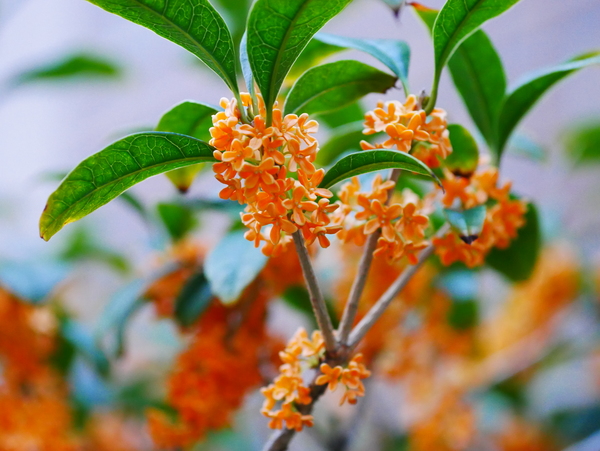
Osmanthus fragrans var. aurantiacus(fragrant orange-colored olive, "Kinmokusei")
Japanese name: キンモクセイ(金木犀) Scientific name:Osmanthus fragrans var. aurantiacus
[Overview]
An evergreen small tree 3–6 m tall. It is dioecious.
The leaves are 8–15 cm long, oblong to oblong-lanceolate and leathery, with a few fine teeth on the upper part.
Several flowers grow in clusters in the leaf axils and bloom in September–October. The corolla is orange-yellow and 4-lobed, with a strong fragrance that can be smelled even from a distance. Only male plants have been confirmed in Japan, so it does not set fruit.
[Uses]
The flowers are used in osmanthus wine (keihi chinshu, wine steeped with the flowers), in flower tea known as osmanthus tea, and in a flavoring called osmanthus paste.
[Cultivation]
Propagate by cuttings.
Avoid poor or dry soil and plant in fertile, well-drained soil.
It tolerates shade, but it is best planted in a sunny place because otherwise it becomes leggy and more prone to insects.
It is sensitive to air pollution such as exhaust fumes, so it may not flower in places with dirty air.
It is weak against salt wind, so it is not suited to places exposed to sea breezes.