
Plant Encyclopedia

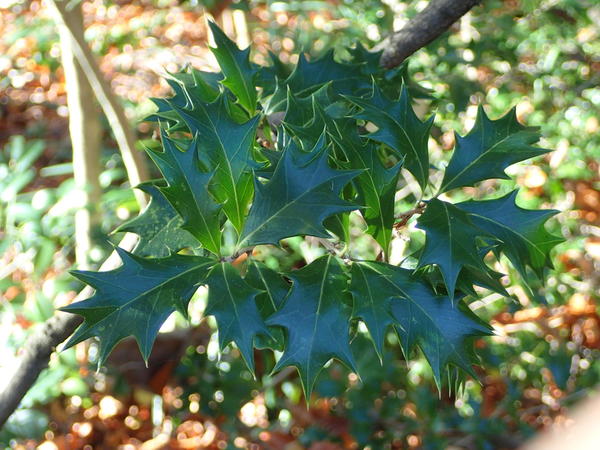
Osmanthus heterophyllus (holly osmanthus, "Hiiragi")
Japanese name: ヒイラギ (柊)
Scientific name: Osmanthus heterophyllus
[Overview]
An evergreen small tree 4–8 m tall, found in the mountains.
It branches freely.
Young twigs and leaf stalks bear fine hairs.
The leaves are simple and opposite, elliptic to obovate-elliptic, 3–7 cm long and 2–4 cm wide, leathery, thick, hard and glossy.
Leaves on young trees have 2–5 pairs of teeth that end in sharp spines.
Leaves on mature trees are entire.
Some plants are male, while others bear bisexual flowers.
Several flowers grow in clusters in the leaf axils; the corolla is white, 4-lobed and fragrant.
The fruit is elliptic, 1.2–1.5 cm long, and ripens to purplish black in early summer of the following year.
[Uses]
The wood is hard and tough, so it is used for tool handles such as those of genno (sledgehammers), and for musical instruments, craftwork and seal stamps.
It has long been believed to ward off evil, and at Setsubun a Hiiragi branch and a sardine head are displayed at the door to drive away demons.
There is also a custom of planting Hiiragi at the kimon (the unlucky northeast direction) and Nanten at the ura-kimon (the southwest).
[Cultivation]
Propagate from seed or cuttings.
Take the seeds from ripe fruit, wash off the pulp thoroughly, and sow them immediately.
Avoid poor or dry ground and places exposed to cold wind; plant in fertile, well-drained soil.
It tolerates shade, but plants become leggy and prone to insects, so a sunny place is best.
For potted plants, water thoroughly when the soil surface dries; for plants in the ground, rainfall is sufficient.
If basal fertilizer is applied, it grows without particular problems unless the ground is poor.
Scale insects can occur.
Details
Japanese: ヒイラギ(柊)、タイワンヒイラギ(台湾柊)、ミヤマモクセイ(深山木犀)
Translated from our Japanese encyclopedia. If anything differs, the Japanese page is correct.