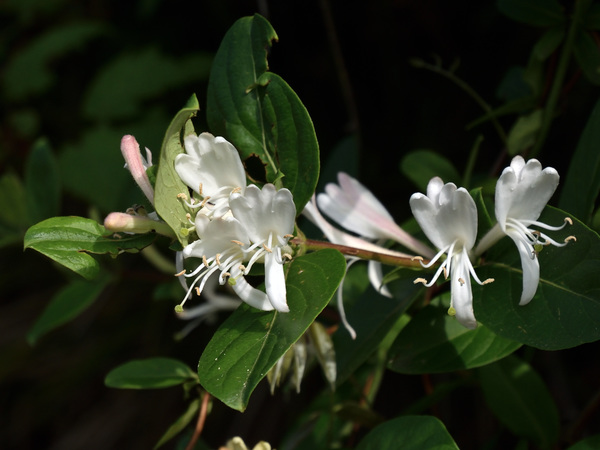
Lonicera japonica var. japonica(Japanese honeysuckle, "Suikazura")
Japanese name: スイカズラ(忍冬) Scientific name:Lonicera japonica var. japonica
[Overview]
A semi-evergreen climbing shrub commonly seen in hills and fields.
The vines twine to the right, and the lower part becomes woody.
Leaves are simple and opposite, 2.5–8 cm long and 0.7–4 cm wide, ovate to oblong-elliptic, with many hairs on the underside.
The leaves usually have entire margins, but early spring leaves and those on weak, overgrown shoots are often pinnately lobed.
The flowers are borne in pairs in the leaf axils, with a pair of ovate bracts at the base.
The flowers are two-lipped, 2.5–3.5 cm long; the upper lip is 4-lobed and the lower lip is slender and hangs down.
The five stamens project far out.
The flowers are first white tinged with pale pink, and later turn yellow.
The flowers have a sweet fragrance and abundant nectar.
The fruit is a spherical berry 5–7 mm across, ripening black.
[Uses]
The buds, stems and leaves are used as a crude drug.
[Cultivation]
Propagate from seed or by cuttings.
It prefers a sunny, well-drained site.
It is easy to grow.
[Notes]
The Japanese name comes from the nectar that collects at the base of the flower and tastes sweet when sucked.
In warm regions it does not lose its leaves even in winter, so it is also called nindo (忍冬).