EVERGREEN

Plant Encyclopedia

Sambucus chinensis var. chinensis

Sambucus chinensis var. chinensis ("Sokuzu")

Japanese name: ソクズ
Scientific name: Sambucus chinensis var. chinensis

Sambucus chinensis var. chinensis

[Overview]
A perennial 1–1.5 m tall, found near human dwellings.
It spreads by sending out underground stems.
The base of the stem becomes woody.
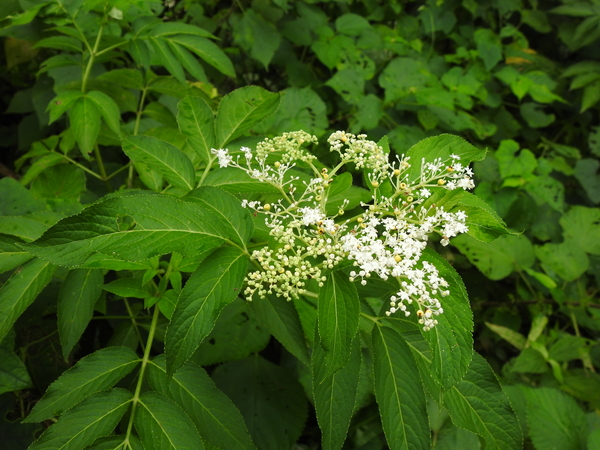
The leaves are opposite and odd-pinnately compound, consisting of 5–7 leaflets.
The leaflets are elliptic to lanceolate, 5–17 cm long and 2–6 cm wide, with fine serrations on the margin.
Large corymbose cymes at the branch tips bear many small flowers.
The flowers are 3–4 mm across, and the corolla is white and deeply 5-lobed.
The fruit is a spherical drupe about mm in diameter and ripens red.

[History]
There is a theory that it was introduced from China as a medicinal plant and then became naturalized.

[Uses]
The whole plant is used medicinally.

Details

Names
Japanese: ソクズ、クサニワトコ、クサタヅ
Life form
Perennial
Habit
Terrestrial
Flowering season
July, August
Distribution or origin
Japan (southern Hokkaido, Honshu, Shikoku, Kyushu), China, Laos, Vietnam, northern Thailand, Myanmar, India, Indonesia, Philippines
Height
1000–1500 mm
Leaf shape
Odd-pinnate compound leaf
Leaf arrangement
Opposite
Leaf margin
Serrate
Inflorescence
Cyme
Flower color
White
Flower diameter
3–4
Fruit color
Red
Uses
Medicinal

Translated from our Japanese encyclopedia. If anything differs, the Japanese page is correct.

Sponsored