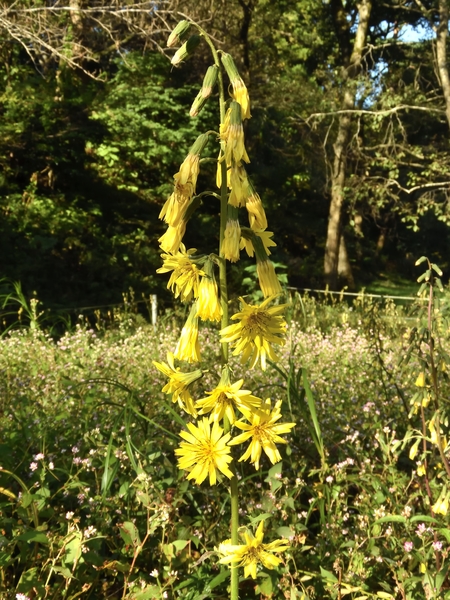
Japanese name: オオニガナ(大苦菜) Scientific name:Nabalus tanakae
[Overview]
A perennial 80–150 cm tall, found in mountain wetlands.
It has creeping rhizomes.
The stem is erect.
There are basal leaves and stem leaves; the basal leaves have withered by flowering.
The stem leaves are arranged alternately and evenly along the stem; they are triangular and divided in a pinnate pattern with a large terminal lobe, and the veins on the underside often have coarse hairs.
The way the leaves are cut varies.
The leaf stalk is 6–16 cm long and has narrow wings.
Many flower heads are borne on the upper part of the stem; they are 3.5–4 cm across, pale yellow, and made up of 26–29 florets, and the tips of the ray florets are finely cut.
The fruit is an achene with a pappus.