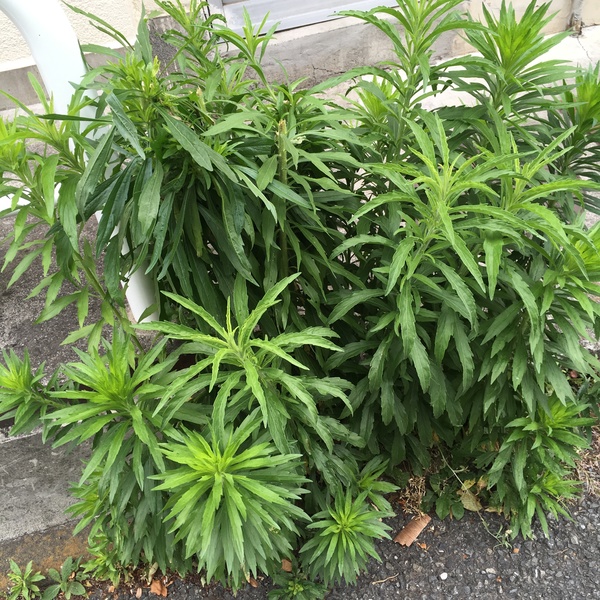
Japanese name: ヒメムカシヨモギ(姫昔蓬) Scientific name:Conyza canadensis
[Overview]
An annual or biennial 1–2 m tall, found along roadsides and in vacant lots.
The stem is densely covered with hairs.
There are basal leaves and stem leaves; the basal leaves are spatulate-oblong, with the veins and leaf stalks tinged reddish purple and sparse hairs on the leaf margins.
The stem leaves are linear to broadly linear, 7–10 cm long and 0.5–1.5 cm wide, entire or sparsely toothed.
The leaf margins have sparse hairs.
The inflorescence at the stem tip bears many flower heads in a panicle.
Around each flower head are 30–80 white ray florets, each with a shallowly 2-lobed tip.
The involucre is about 3 mm.
The fruit is an achene with a pappus.
[History]
It has become naturalized widely around the world.
It came to Japan in the early Meiji period.