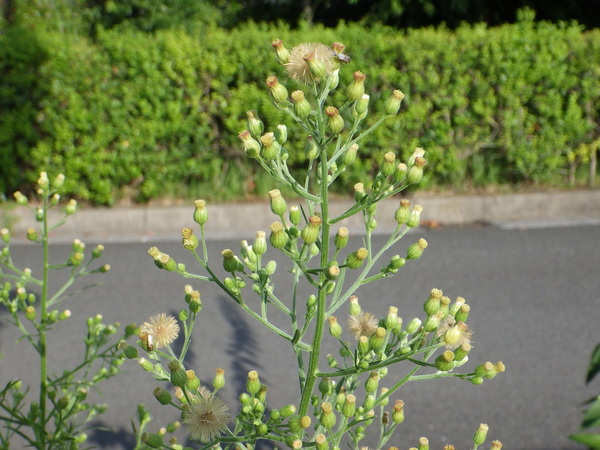
Japanese name: オオアレチノギク(大荒地野菊) Scientific name:Conyza sumatrensis
[Overview]
A biennial 1–1.8 m tall, found along roadsides and in vacant lots.
The whole plant is densely covered with soft hairs.
There are basal leaves and stem leaves; the basal leaves are oblanceolate.
The stem leaves are linear-oblanceolate to linear-lanceolate, 8–15 cm long and 1–2 cm wide, entire or sparsely toothed.
Both sides of the leaves are densely covered with soft hairs.
The inflorescence at the stem tip bears many flower heads in a panicle.
The flower heads are dull white to pale yellow and have many ray florets, but these are small and inconspicuous, so the heads look as if they have no petals.
The involucre is about 5 mm.
The fruit is an achene with a pappus.
[History]
It has become naturalized widely in the warm-temperate to tropical regions of the world.
It came to Japan in the early Showa period.