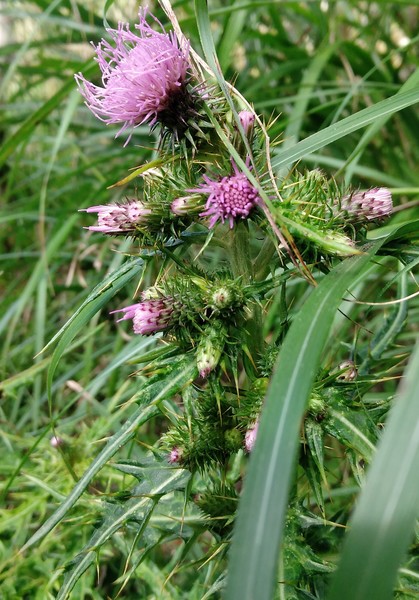
Japanese name: ヤマアザミ(山薊) Scientific name:Cirsium spicatum
[Overview]
A perennial 1.5–2 m tall, found in mountain grasslands.
It sometimes forms large colonies beside pastures and similar places.
It is also found on limestone ground.
The stem is thick and erect, and branches freely into short branches, giving the plant a slender columnar form.
The upper part of the stem has brown hairs and cobwebby hairs.
There are basal leaves and stem leaves; the basal leaves have withered by flowering time.
The stem leaves are alternate, broadly elliptic to elliptic-lanceolate, 12–35 cm long and 5–12 cm wide, pinnately divided into 4–6 pairs of lobes, with spines at the lobe tips.
The leaves usually have brown hairs on the upper surface and cobwebby hairs on the underside, and often lack a leaf stalk.
Many reddish-purple flower heads are borne in a spike in the upper part of the stem, and the heads are stalkless.
The involucre is cylindrical to narrowly bell-shaped, 0.5–1.2 cm wide, with involucral bracts in 7–9 rows that are recurved and end in sharp spines.
The involucral bracts have no glands and are not sticky.
The fruit is an achene with white pappus hairs.