
Plant Encyclopedia

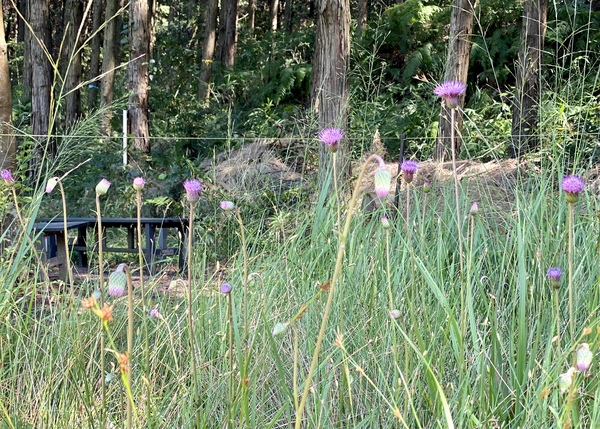
Cirsium sieboldii ("Kiseruazami")
Japanese name: キセルアザミ (煙管薊)
Scientific name: Cirsium sieboldii
[Overview]
A perennial 40–120 cm tall, sometimes over 3 m, found in wetlands, stream edges and paddy-field ridges from lowlands to mountains.
The stem is erect or ascending, and is either unbranched or branches several times in the upper part.
There are basal leaves and a few alternate leaves on the stem; the basal leaves persist at flowering time, are narrowly obovate and 13–47 cm long, and are either pinnately divided into 5–9 pairs of lobes, or undivided with entire or toothed margins.
The leaves are rather thick, fleshy and glossy.
One or several reddish-purple flower heads, 2–3 cm across, are borne in a raceme at the stem tip, facing downward.
The involucre is bell-shaped to cylindrical, 1.1–1.9 cm wide, with involucral bracts in 8–10 rows that are pressed flat without recurving and tinged purplish brown; the glands on the inner bracts are vestigial and not sticky.
The flowers turn upward by the time the fruit ripens.
Occasionally, individuals are found whose flower heads face upward from the start of flowering.
The fruit is an achene with white pappus hairs.
[Notes]
The name comes from the way the flowers are borne.
Details
Translated from our Japanese encyclopedia. If anything differs, the Japanese page is correct.