
Plant Encyclopedia

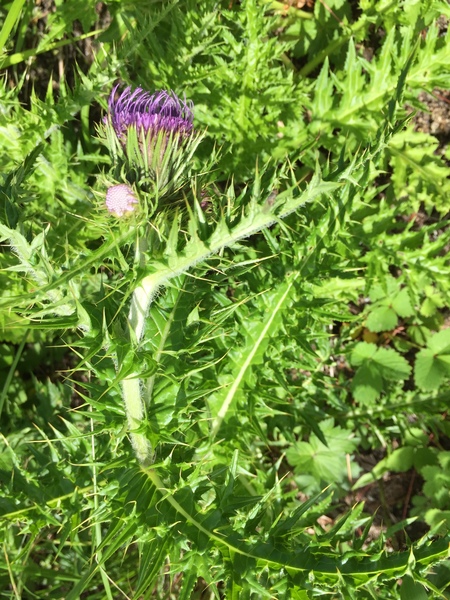
Cirsium nambuense ("Nanbutakaneazami")
Japanese name: ナンブタカネアザミ (南部高嶺薊)
Scientific name: Cirsium nambuense
[Overview]
A perennial 30–50 cm tall, found in the Tohoku region, growing in grassland mixed with rocks on wind-swept sites in high mountains.
The stem is erect or ascending, sometimes branches 1–3 times in the upper part, and is densely covered with white curly hairs.
There are basal leaves and alternate stem leaves; the basal leaves remain at flowering time.
The leaves on the lower part of the stem are elliptic to ovate, 8–21 cm long and 7–12 cm wide, and are pinnately divided into 8–13 pairs of lobes.
The leaves are thick and glossy, and the leaf margins have spines.
The flower heads usually face upward at the stem tip, are solitary or densely clustered in groups of 2–4, are reddish purple, and are almost stalkless.
The involucre is bell-shaped, 1.8–2.3 cm wide, green to purplish brown, with cobwebby hairs.
The involucral bracts are in 5–6 rows and are ascending or recurved.
The inner involucral bracts have glands, and the involucre is slightly sticky.
The fruit is an achene with white pappus.
Details
Translated from our Japanese encyclopedia. If anything differs, the Japanese page is correct.