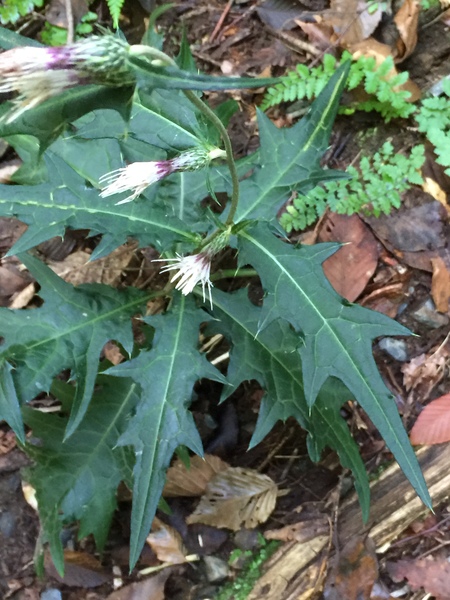
Cirsium microspicatum var. microspicatum("Azumayamaazami")
Japanese name: アズマヤマアザミ(東山薊) Scientific name:Cirsium microspicatum var. microspicatum
[Overview]
A perennial 70–200 cm tall, found at forest edges and in grasslands from low mountains to mountain regions.
The stem is erect or ascending and branches well in the upper part.
There are basal leaves and stem leaves; the basal leaves have withered by flowering time.
The stem leaves are alternate, elliptic to lanceolate and 20–50 cm long, and are pinnately divided into 3–6 pairs of lobes, or undivided with toothed or entire margins.
The upper surface of the leaves often has white blotches along the veins, and the margins have spines.
The flower heads are borne at the stem tip in a raceme-like to spike-like arrangement and are pale reddish purple; the involucre is cylindrical to narrowly bell-shaped, 0.6–1.2 cm wide, and purplish brown, and the involucral bracts are in 11–12 rows.
Plants with a markedly sticky involucre are called Nebari-azuma-yama-azami.
The fruit is an achene with white pappus.
[Notes]
The name derives from the fact that, in contrast to Yama-azami, which is common in western Japan, this plant is common in eastern Japan.