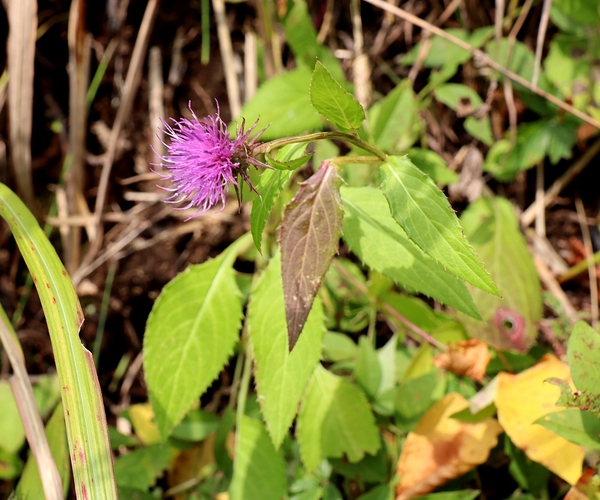
Cirsium dipsacolepis var. dipsacolepis("Moriazami")
Japanese name: モリアザミ(森薊) Scientific name:Cirsium dipsacolepis var. dipsacolepis
[Overview]
A perennial 50–100 cm tall, found in mountain grasslands.
The root, which can reach 2 cm across, extends deep vertically.
The stem is erect.
There are basal leaves and stem leaves; the basal leaves have withered by the flowering season.
The stem leaves are alternate; the lower ones are lanceolate to ovate, 10–15 cm long.
The leaves are either pinnately divided into 3–5 pairs of lobes, or undivided with toothed margins, and have sharp spines.
One to several flower heads are borne at the stem tip.
The flower heads are pale reddish purple and face upward.
The involucre is bowl-shaped to broadly bell-shaped, 1.5–2 cm wide, and the involucral bracts are reflexed or spreading, in 6–7 rows.
The involucral bracts have no glands and are not sticky.
The fruit is an achene with a pappus.
[Uses]
The root is eaten, for example pickled in miso.
[Cultivation]
Propagate from seed.
It prefers a sunny, well-drained site.